









Restoration begins on Michelangelo’s Last Judgment in the Sistine Chapel, 30 years after the “restoration of the century.”
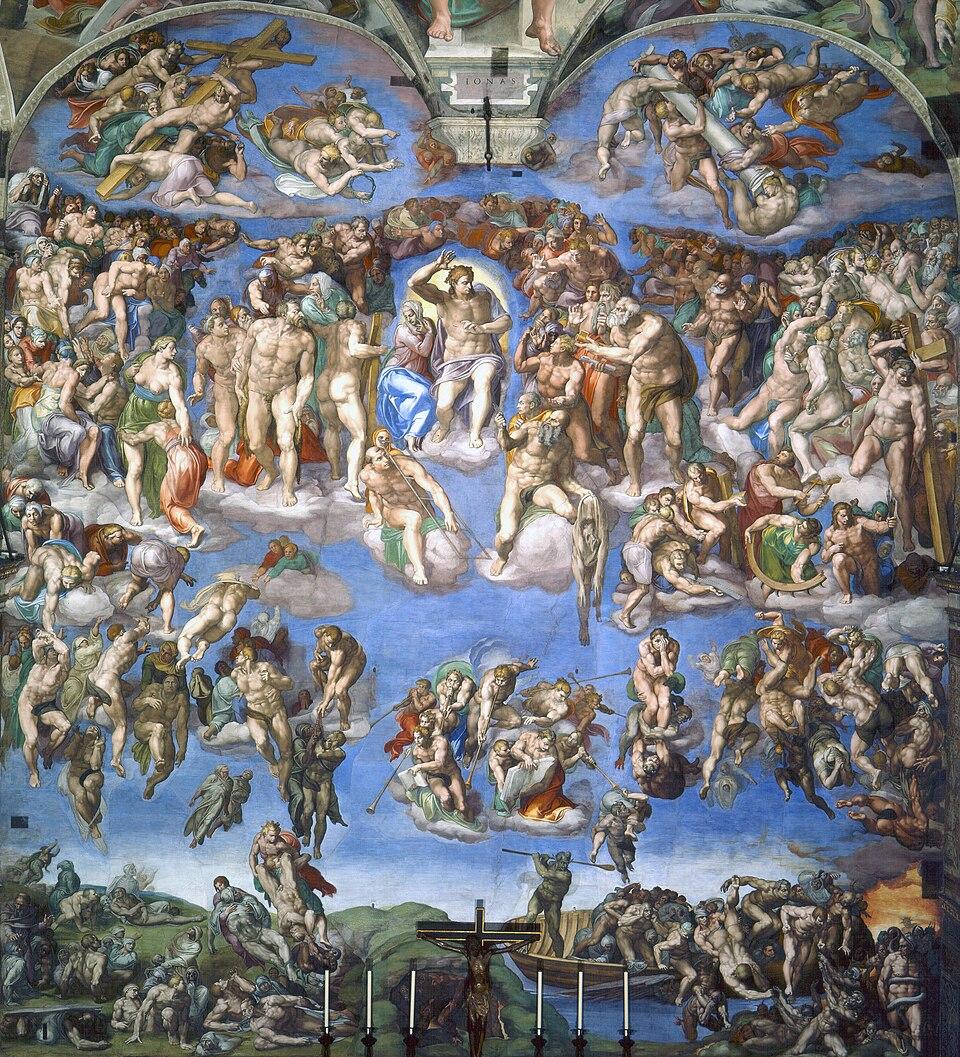
Newsroom (02/02/2026 Gaudium Press ) The Vatican Museums have begun installing scaffolding in the Sistine Chapel to launch an extraordinary maintenance and cleaning campaign on Michelangelo’s Last Judgment. The project, entrusted to the Museums’ own Laboratory of Restoration, will last about three months.
According to an official communiqué released by the Vatican Museums, the intervention marks the start of a new conservation phase, coming more than thirty years after the celebrated “restoration of the century,” which unveiled the fresco’s luminous and vibrant hues in the 1990s.
The “White Veil” Problem
The new cleaning was deemed necessary after conservators detected a subtle, whitish film across portions of the fresco. Paolo Violini, head restorer of the Vatican Museums’ Laboratory of Paintings and Wooden Materials, explained that this layer resulted from “micro-particles of foreign substances carried by air currents, which over time dulled the contrasts of light and shadow and flattened the original color harmonies.”
The scientific analysis revealed that these deposits, though thin and non-destructive, had uniformly softened Michelangelo’s dramatic palette. The upcoming cleaning aims to restore the extraordinary chromatic intensity and luminous balance that define the work.
Sistine Chapel to Stay Open
Despite the scale of the operation, the Vatican confirmed that the Sistine Chapel will remain open throughout the restoration period. Pilgrims and tourists will continue to visit under the frescoed vaults of Michelangelo, as restorers—working discreetly behind a high-definition screen reproducing the Last Judgment—carry out their delicate procedures.
The scaffolding, which covers the entire altar wall, has been specially designed to allow both precision work and an uninterrupted flow of visitors. The initiative is supported by the Florida Chapter of the Patrons of the Arts in the Vatican Museums and involves several Vatican departments, including the Scientific Research Cabinet, the Office of the Conservator, and the Photographic Laboratory.
Continuing a Legacy of Care
The forthcoming operation continues a legacy of vigilance that began with the grand restoration completed in 1994 under Director General Carlo Pietrangeli and chief restorer Gianluigi Colalucci. Since then, Vatican specialists have conducted ongoing diagnostic studies to monitor the condition of the frescoes amid the intense daily influx of visitors.
In recent years, teams have carried out preventive maintenance across the Chapel’s walls, lunette frescoes, and papal portraits using mobile platforms—usually during nighttime hours—to remove surface dust and atmospheric residues. This regular care has preserved the overall brilliance of the Renaissance masterworks and extended their stability.
A Monument to Wonder
The Last Judgment, painted between 1536 and 1541 on the altar wall of the Sistine Chapel, remains one of the most awe-inspiring compositions in Western art. Commissioned by Pope Clement VII and completed under Paul III, the monumental fresco spans 180 square meters and features 391 figures, each rendered with Michelangelo’s unflinching expressiveness.
At its unveiling on October 31, 1541, the work provoked astonishment among contemporaries; as Giorgio Vasari wrote, it “filled the world with stupor and wonder.” More than four centuries later, that same wonder continues to draw millions of visitors each year—now accompanied by the quiet presence of restorers ensuring that Michelangelo’s vision remains radiant for generations to come.
- Raju Hasmukh with files from Vatican News
Related Images: