
















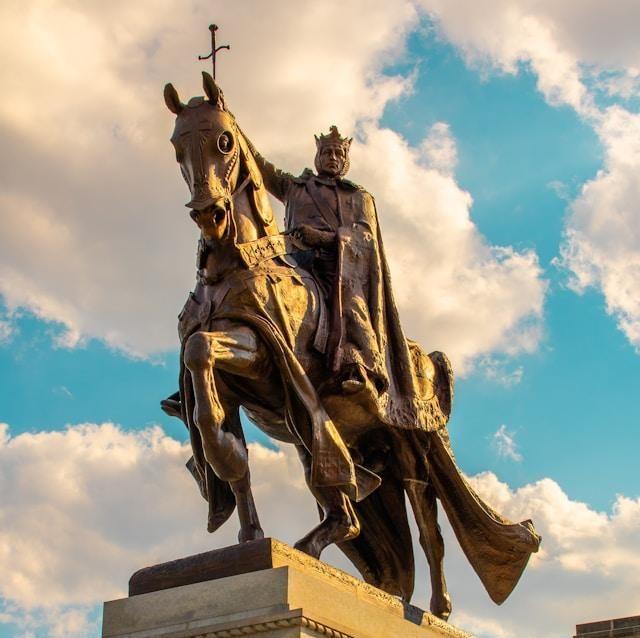
Remembering Saint Louis IX: king, crusader, and saint — his justice, charity, and death on crusade recounted for the faithful.
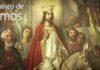
Newsroom (August 30, 2025, Gaudium Press)- Today we commemorate the great King Louis IX, the Saint. In an era when the purity of Christian intent began to waver, Saint Louis rekindled the myth of the crusades.
Saint Louis King of France, Saint Louis IX , a mythical name that takes us into the sphere of the unreal-real.
He was born April 25, 1214, near Paris, son of Louis VIII and the great Blanche of Castile. This Spanish woman of faith passed on to him the love of the Catholic religion. She would tell him that she would prefer to see him dead than stained with a mortal sin. Those were times… which, with the favor of the Immaculate Heart of the Virgin, will return.
When he was 12 years old his father, the King, died. And following his orders, he was crowned at that age in Reims, under the regency of his mother.
At age 20 he married Margaret of Provence, with whom he would raise 11 children. He himself, after reciting Compline, would gather them and tell them the lives of the saints, encouraging them to virtue. He taught them to pray, to attend Mass frequently, to pray the liturgical hours — a complete religious instruction. He also recited the canonical hours, frequently read the Sacred Scripture and the Fathers of the Church. He went to confession often, and would not allow the confessor there in that tribunal to call him majesty, because he said that there the priest was not a subject but a father, and he was not king there, but a son.
A kind king, a just judge, he made himself loved and also feared.
When he received complaints that some magistrate was acting badly, he appointed extraordinary judges to examine their conduct. He rewarded good servants, and punished the bad by example. He was kind, but he made himself respected, and feared.
His own judgments in the forest of Vincennes became famous. Here is how his biographer Joinville recounts it:
It often happened that, after Mass, he would sit in the forest of Vincennes, under an oak, and made us sit around him. And all those who had a question to resolve came to speak with him, without obstacles of guards or anything of the sort. Then he would ask them: ‘Does anyone want to present a complaint?’ Those who had claims to make would stand up. He then said to them: ‘Be quiet all of you, you will be attended to one after another’. Then he would appoint Monsignor Perronde Fonteinnes and Monsignor Geffroy de Villete [great jurists] and tell one of them: “Settle this litigation”. And when he perceived something to correct in the words of those who spoke in his name, or on behalf of one of the parties, he himself made the correction.
He reproached Joinville for preferring to commit a mortal sin rather than contract leprosy, telling him that it was not guaranteed, at the moment of death, sufficient repentance to gain peace with God.
Heroic charity
To a monk who suffered from leprosy, Saint Louis would visit regularly, and they say that on one occasion he helped him to eat, placing pieces of meat in his devastated mouth. He helped the poor in an outstanding way.
In August of 1248 he departed for Aigues-Mortes, a French port, to command the Seventh Crusade. In June of the following year Louis IX conquered Damietta in Egypt. But after wrong steps taken by his subordinates, especially his brother Robert, and after facing hunger and the plague, he fell prisoner in April 1250. The captors admired his courage, the greatness of his soul.
After paying a large ransom, he surrendered Damietta, then left for Saint John of Acre (today Acre, in Israel) and remained in the East for four years, greatly favoring the Christian cause.
In the spring of 1252, Blanche of Castile died, which caused him to return to France in 1254.
He died on his second crusade.
In July of 1270 he left for a new crusade, and this time he headed for Tunis; he easily took Carthage, but soon under the torrid African sun, poor water supplies, and bad hygienic conditions, the crusading army was decimated as a result of an epidemic. The king was among those struck.
On the eve of his death he wished to be placed in ashes, with his arms in the form of a cross. They heard St Louis IX murmur: “Lord, I will enter into your house and worship you in your holy tabernacle!”. He died on August 25, 1270.
With information from Arautos.org
Compiled by Adele Wong.
Related Images: