













Restoration of Bethlehem’s sacred Grotto of the Nativity begins, marking rebirth, unity, and hope for the Holy Land.
Newsroom (27/01/2026 Gaudium Press ) In Bethlehem, the air is filled with a rare sense of anticipation and renewal. For the first time in six centuries, the Grotto of the Nativity—the revered site where Christians believe Jesus was born—is set to undergo a full restoration. Announced jointly by the Greek Orthodox Patriarchate of Jerusalem and the Custody of the Holy Land, the initiative represents more than a technical project: it is a profound act of unity and faith.
The ambitious restoration effort, carried out under the auspices of the Presidency of the State of Palestine, extends beyond ecclesiastical cooperation. It draws together the Greek Orthodox, the Franciscans representing the Custody of the Holy Land, and the Armenian Apostolic Orthodox Patriarchate. Their shared commitment symbolizes the ecumenical spirit that has quietly endured amid centuries of division, war, and difficulty in the region.
A Presidential Vision for Rebirth
When Palestinian President Mahmoud Abbas visited Rome in November 2025, his words cast light on the broader meaning behind the work. Standing beside Pope Leo XIV, Abbas described the project as “a sign of great hope and rebirth for the whole Holy Land.” His statement coincided with the inauguration of Bethlehem Reborn, an exhibition celebrating the city’s spiritual and historical legacy.
The President’s decree, issued in 2024, formally initiated the multi-faith collaboration to restore the sacred site. Today, that vision materializes in stone, marble, and faith. For Bethlehem—a city often strained by political and economic hardships—the restoration promises not only spiritual renewal but also tangible economic relief.
Italian Expertise and Local Impact
An Italian restoration company from Prato, renowned for its meticulous rehabilitation of the Basilica of the Nativity just two years ago, has been entrusted with the new project. Their proven craftsmanship ensures continuity in both methods and artistic sensibility, essential for handling a site of unparalleled sacred significance.
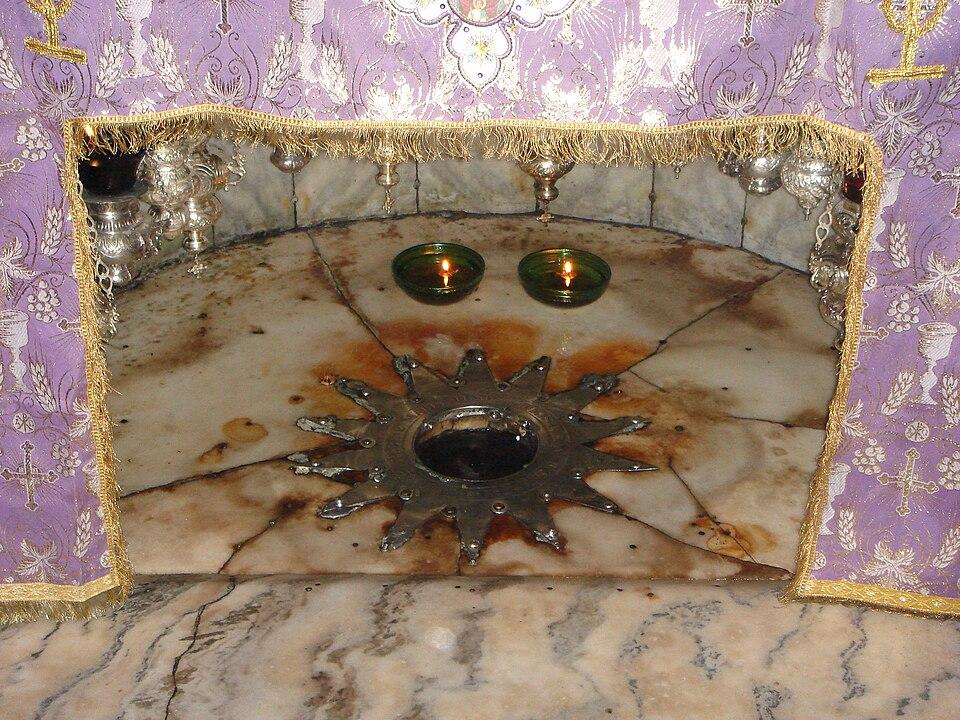
According to the Custody of the Holy Land, the preparations are complete, and work is set to begin. The project will address the Grotto’s most fragile elements: the weathered rock, marble floors, ancient columns, and the silver star marking the very spot of Christ’s birth. Reinforcement work in adjacent sections will also preserve the architectural unity of the complex.
The restoration carries an economic dimension as well. Many local artisans and workers, trained in heritage preservation, will be directly employed. In a region still reeling from the aftermath of the Israel-Hamas conflict and the temporary collapse of pilgrimages, this initiative provides both livelihood and renewed purpose. As tourism cautiously revives in step with “Phase 2” of U.S. President Donald Trump’s peace plan, Bethlehem finds in this project a pathway toward economic and moral recovery.
Faith in Stone and Light
Beyond its material aims, the work at the Grotto of the Nativity stands as an emblem of faith, dialogue, and preservation. The joint statement from the Greek Orthodox Patriarchate and the Custody underscores this: the initiative “embodies a unified Christian commitment to preserve the spiritual, historical, and cultural patrimony of the Holy Grotto for future generations.”
The project reaches deep into the heart of Christian belief. “In the Grotto,” the statement explains, “the mystery of the Incarnation entered history, and the Christian confession received its earthly beginning.” To restore this sacred site, therefore, is to protect the continuity of faith itself—a living testimony that transcends borders and generations.
From the dimly lit cave beneath the basilica, where whispers of ancient devotion still echo, Bethlehem’s light spreads outward once more. As the Churches of Jerusalem join hands to restore the “cradle of Christianity,” they also reaffirm a universal truth: that healing—of stone, faith, and humanity—often begins at the place of our shared beginnings.
- Raju Hasmukh with files from Vatican News
Related Images: