














As 2026 dawns, the reflections of popes through the decades urge gratitude for time past and hope for what lies ahead—a faith anchored in renewal.
Newsroom (31/12/2025 Gaudium Press ) Each year’s end brings a pause—a breath taken between what has been lived and what is yet to come. For the Church, this movement from one year to another is more than a change of calendars. It is a sacred threshold, a brief stillness that invites reflection, gratitude, and the steady courage of hope. As 2026 approaches, Vatican voices past and present remind the faithful that faith’s gaze looks both backward in thanksgiving and forward in trust.
This dual horizon—thanksgiving and hope—has long shaped papal reflections on time itself. From Saint Paul VI’s meditations on the fleeting present to Pope Francis’s call for kindness as a civic virtue, the voices of the Popes converge on one truth: time, fragile and fleeting, is where grace dwells.
The meaning of time
In his Angelus message on January 2, 1972, Saint Paul VI invited the faithful to confront the mystery of time itself. To him, each passing instant was more than chronology—it was a living presence demanding attention. He described time as a measure that inspires both awe and responsibility, a reminder that “we live only on a moving point, a single fleeting moment.” In this fragility lies our task: to live each moment with “reasonable intensity,” as time’s value can only be measured through the life and love we pour into the present.
Gratitude at year’s end
For Pope Benedict XVI, the Church’s closing of the year must ring with thanksgiving. On December 31, 2011, as he led the Te Deum in St. Peter’s Basilica, he reminded the world that the final hour of history—and of each individual life—belongs to God. Gratitude becomes not mere sentiment but an act of clarity, a way to find meaning in time’s passage. “To overlook this goal of our lives,” he warned, “would be to fall into the void.” The Te Deum hymn, sung by generations of believers, thus becomes an anchor amidst the shifting sands of the calendar—a melody of faith against forgetting.
Hope that generates life
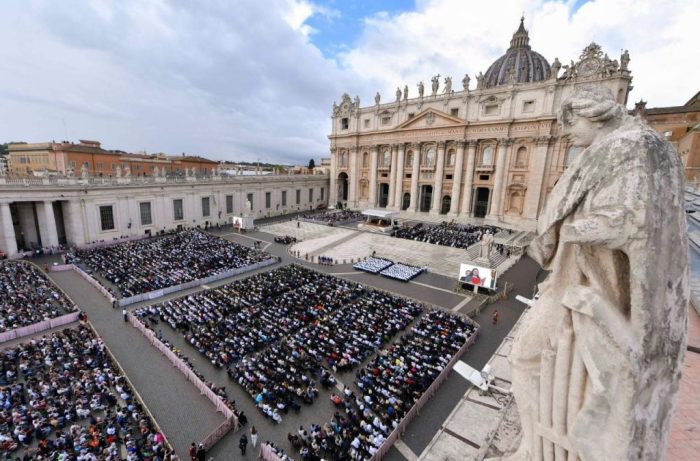
As the Jubilee of Hope draws to a close, Pope Leo XIV brought the message full circle: hope does not end with a year. “Without hope, we are dead; with hope, we come to the light,” he told pilgrims in December 2025. Hope, he explained, is not a fragile optimism but divine strength—“a theological virtue” that gives birth and rebirth. In a world tempted by cynicism, his words seek to rekindle what he calls the true strength of God: generative hope, capable of creating life where despair would only destroy.
Writing the blank page
Saint John Paul II, speaking on January 1, 1986, captured the uncertainty of the new year with simple imagery: the “blank page.” Each January invites humanity to choose what will be written across it—deeds of peace or conflict, compassion or neglect. For him, the unknown space of the coming year was a battleground for good and evil, within the heart of each person and the fabric of society itself.
The strength of kindness
In more recent years, Pope Francis has placed this same struggle within the realm of daily virtue. As 2022 closed, he turned his gaze toward the human city, urging believers to “retrieve kindness” as a path of renewal. Kindness, he said, humanizes life; it softens indifference and tempers aggression. In a fractured world, it becomes the first act of rebuilding community—a civic virtue as much as a spiritual one.
Building houses that endure
More than half a century earlier, Saint John XXIII offered a vision rooted in the same hope, but through the quiet labor of family life. In 1960, he urged families to build “a house that does not collapse”—one grounded in prudence, forgiveness, and shared sacrifice. His New Year’s wish reached out especially to those burdened by poverty and pain, offering the assurance of a prayerful solidarity that transcends circumstance.
The inheritance of faith
Across decades and generations, these papal reflections open a shared space of faith—one where time becomes less a measure of aging and more a measure of becoming. Whether through gratitude for what has been or hope for what may come, each Pope has traced the same contour: life’s meaning unfolds at the meeting point of the present moment and eternity.
As the world steps into 2026, their voices converge into a single blessing: that we may continue to be pilgrims of hope, building—despite uncertainty and conflict—a house that does not collapse.
- Raju Hasmukh with files from Vatican News
Related Images: