

















Pope Leo XIV marks 125th anniversary of Sant’Anselmo Church, urging Benedictines to place Christ at life’s core to face unprecedented modern trials.
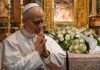
Newsroom (12/11/2025 Gaudium Press ) Pope Leo XIV called on the Benedictine Order to confront the rapid upheavals of contemporary society by anchoring their lives and mission in Christ, during a Mass celebrating the 125th anniversary of the dedication of the Church of Sant’Anselmo all’Aventino on Tuesday, November 11.
Presiding over the liturgy at the historic church atop Rome’s Aventine Hill, the pontiff addressed monks, scholars, and faithful gathered in the complex overseen by the Benedictine Confederation, the global governing body of the Order of St. Benedict. The site also houses the abbot primate, currently Abbot Jeremias Schröder, his curia, the Pontifical Atheneum of Sant’Anselmo, and a residential college.
“The sudden changes we are witnessing provoke and question us, raising issues that have never been seen before,” Pope Leo XIV said in his homily. He emphasized that the anniversary serves as a reminder that, like St. Peter, St. Benedict, and countless others, today’s faithful can only fulfill their vocation “by placing Christ at the center of our existence and our mission, starting from that act of faith that makes us recognize Him as the Savior and translating it into prayer, study, and commitment to a holy life.”
Drawing historical parallels, the Pope recalled how his 19th-century predecessor, Pope Leo XIII, vigorously supported the expansion of the Sant’Anselmo complex and the Benedictine Confederation. Leo XIII believed the order could greatly aid God’s people during the turbulent shift from the 19th to the 20th century, a period rife with challenges.
Pope Leo XIV extolled monasticism’s enduring role as a “frontier” since its inception, where “courageous men and women” founded centers of prayer, work, and charity in remote and inhospitable regions. These efforts, he said, converted barren lands into productive ones—not only economically but, more profoundly, spiritually.
“The monastery, thus, has increasingly characterized itself as a place of growth, peace, hospitality, and unity, even in the darkest periods of history,” the pontiff continued.
He urged the Sant’Anselmo community to evolve into a “beating heart” for the worldwide Benedictine family, with the church as its core, in line with St. Benedict’s teachings. The Pope praised existing manifestations of holy living at the complex, including the liturgy, Lectio Divina, scholarly research, pastoral outreach, and inclusive engagement with monks from diverse nations alongside clerics, religious, and laypeople of varied backgrounds.
Calling for continued growth as an authentic “school of the Lord’s service,” he referenced the Mass’s first reading from the Prophet Ezekiel, depicting a river flowing from the Temple. This, he explained, symbolizes a heart pumping lifeblood to nourish every part of the body for the common good. The second reading’s image of a “spiritual house” built on Christ as the cornerstone reinforced his message.
“In the industrious hive of Sant’Anselmo, may this be the place where everything begins and to which everything returns to find verification, confirmation, and deeper understanding before God,” Pope Leo XIV insisted. He expressed hope that the institution would convey a “prophetic message” to the Church and world: to live as a chosen people proclaiming “the admirable works of Him who called us out of darkness into His marvellous light.”
Reflecting on the dedication of a sacred space, the Pope described it as a “solemn moment” uniting space and time, the finite and infinite, humanity and divinity. Quoting the Second Vatican Council’s Sacrosanctum Concilium, he noted the Church’s dual nature—human and divine—where the visible serves the invisible, action yields to contemplation, and the present anticipates the heavenly city.
This, he said, mirrors humanity’s universal quest for ultimate truth, revealed not by “flesh nor blood” but by the Father, culminating in Jesus as “the Christ, the Son of the living God.”
Concluding his address, Pope Leo XIV exhorted the assembly to seek Jesus and share Him with others, “grateful for the gifts he has given us, and above all for the love with which He has preceded us.” In doing so, the temple would become “a place of joy, where we experience the beauty of sharing with others what we have received freely.”
- Raju Hasmukh with files from vatican.va
Related Images: