











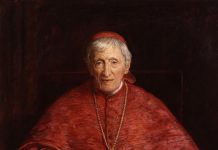

This proclamation will elevate Newman to the 38th doctor of the Church, placing him among an elite group of saints recognized for their lasting impact on Catholic thought and spirituality
Newsroom (29/09/2025, Gaudium Press ) Pope Leo XIV announced on Sunday that St. John Henry Newman will be proclaimed a doctor of the Church on November 1, coinciding with the solemnity of All Saints. The declaration will honor Newman’s profound contributions to Catholic theology, particularly his insights into the development of doctrine and the role of conscience.
Speaking after celebrating Mass for the Jubilee of Catechists in St. Peter’s Square, the pope said, “I will confer the title of doctor of the Church on St. John Henry Newman, who gave a decisive contribution to the renewal of theology and to understanding Christian doctrine in its development, in the context of the Jubilee of the World of Education.”
This proclamation will elevate Newman to the 38th doctor of the Church, placing him among an elite group of saints recognized for their lasting impact on Catholic thought and spirituality. The title is reserved for those whose writings and teachings have shaped the Church’s understanding of faith across centuries.
A Life of Faith and Intellect
Born on February 21, 1801, in London, John Henry Newman was a towering figure in 19th-century religious thought. Initially an Anglican priest and a leading voice in the Oxford Movement, which sought to renew the Church of England by reviving its Catholic roots, Newman’s intellectual journey led him to question Anglicanism’s foundations. His rigorous study of Church history and theology culminated in his conversion to Catholicism in 1845, guided by Blessed Dominic Barberi, an Italian Passionist priest.
Ordained a Catholic priest in 1847, Newman founded the Oratory of St. Philip Neri in Birmingham, England, establishing a community dedicated to prayer, preaching, and education. His scholarly works, including An Essay on the Development of Christian Doctrine and The Idea of a University, remain influential in theological and educational circles. In 1879, Pope Leo XIII named him a cardinal, recognizing his contributions to the Church despite his preference for a life of study and pastoral work over ecclesiastical honors.
Newman’s writings emphasized the organic growth of Christian doctrine, arguing that authentic development preserves the Church’s core truths while adapting to new contexts. His reflections on conscience as a pathway to God have also resonated deeply, offering a framework for understanding personal moral responsibility within the Church’s teachings.
Newman died on August 11, 1890, in Birmingham. He was beatified by Pope Benedict XVI in 2010 and canonized by Pope Francis in 2019, following miracles attributed to his intercession. His feast day is celebrated on October 9, the anniversary of his 1845 reception into the Catholic Church.
A Lasting Legacy
Newman’s designation as a doctor of the Church underscores his enduring relevance. His work continues to inspire theologians, educators, and Catholics navigating the complexities of faith in the modern world. The November 1 proclamation, set against the backdrop of the Jubilee of the World of Education, highlights Newman’s contributions to Catholic intellectual life and his vision for education as a pursuit of truth and holiness.
As the Church prepares to celebrate All Saints’ Day, the recognition of St. John Henry Newman as a doctor of the Church reaffirms his role as a guiding light for those seeking to deepen their understanding of faith, reason, and the evolving life of the Church.
- Raju Hasmukh with files from CNA
Related Images: