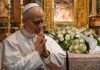














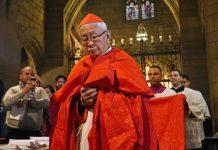
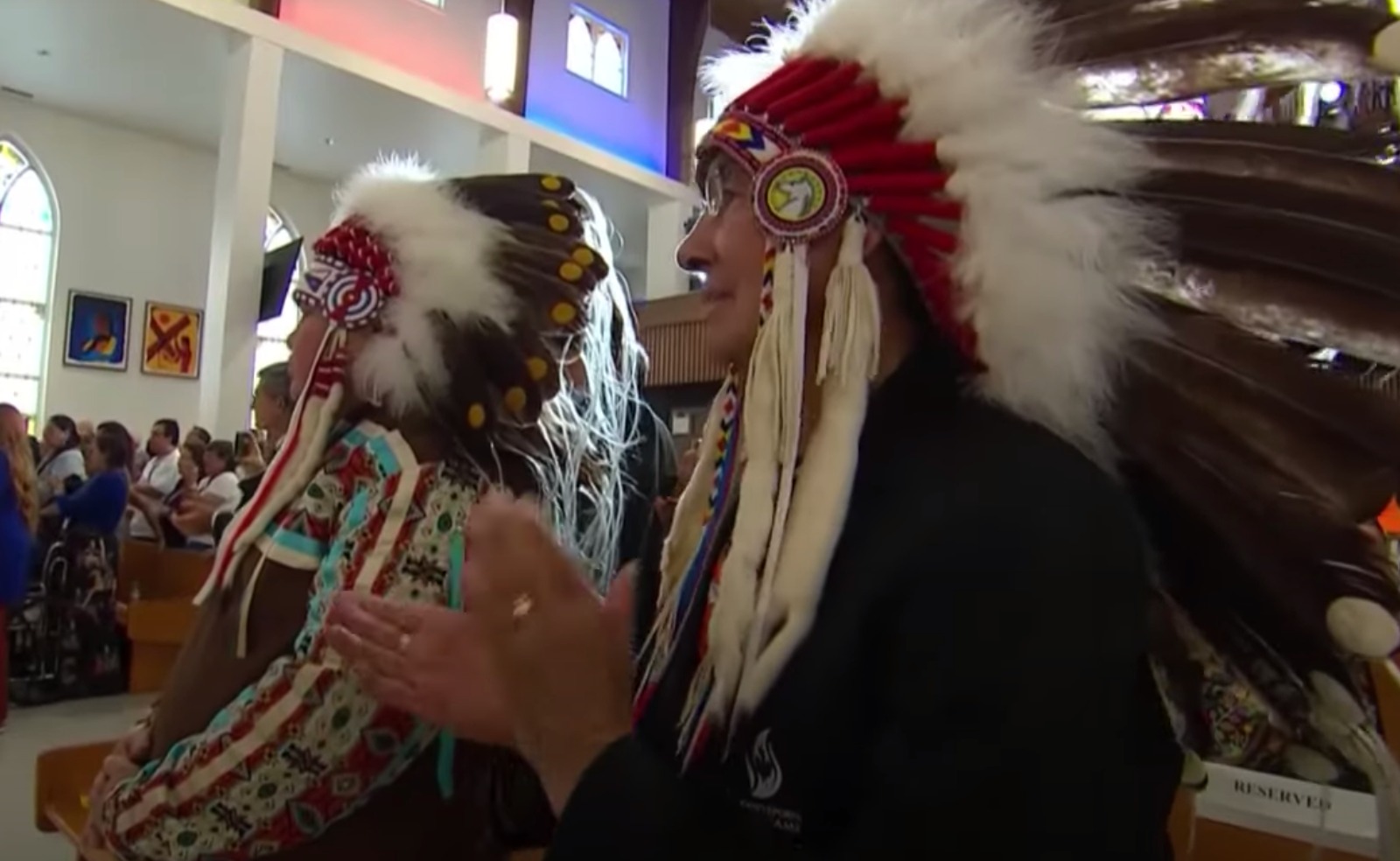
Pope Leo XIV hands over 62 Indigenous artifacts, including an Inuit kayak, to Canadian bishops in a Vatican ceremony marking 100 years since they were taken for a 1925 exhibition.
Newsroom (17/11/2025 Gaudium Press ) In a poignant ceremony Saturday, Pope Leo XIV personally returned 62 Indigenous cultural objects to a delegation from the Canadian Conference of Catholic Bishops, bringing to a close a century-long chapter that began when the items were removed from First Nations, Inuit, and Métis communities for display in Rome.
The artifacts — among them an intact Inuit kayak, wampum belts, ceremonial masks, war clubs, and other objects central to Indigenous spiritual and cultural life — had been housed in the Vatican’s Anima Mundi ethnographic museum since 1925. They were originally sent by Canadian missionaries for a grand Vatican exhibition that celebrated the Church’s global missionary reach during that year’s Holy Year under Pope Pius XI.
The Vatican has long described the objects as “gifts” to Pius XI. Indigenous leaders and historians, however, have consistently challenged that characterization, pointing to the extreme power imbalance that existed between Catholic missionaries and Indigenous communities at the time. Many of the items were confiscated under Canada’s potlatch ban and other assimilation policies that the Church helped enforce, policies later labeled “cultural genocide” by Canada’s Truth and Reconciliation Commission.
Saturday’s handover, deliberately timed to coincide with the current Holy Year — exactly 100 years after the 1925 exhibition — was framed by both the Vatican and the Canadian bishops as a “concrete sign of dialogue, respect and fraternity.”
“This is an act of ecclesial sharing,” the joint Vatican–Canadian statement read, “with which the Successor of Peter entrusts to the Church in Canada these artifacts, which bear witness to the history of the encounter between faith and the cultures of the Indigenous peoples.”
Canadian bishops have committed to act only as temporary custodians. The objects will first travel to the Canadian Museum of History in Gatineau, Quebec, where Indigenous knowledge keepers and museum specialists will work to identify the precise communities of origin and determine the appropriate long-term repatriation path. Officials stressed that ultimate control will rest with the Indigenous nations themselves.
The repatriation is the direct outcome of a process that accelerated after Pope Francis’s historic 2022 meetings with First Nations, Inuit, and Métis delegations in Rome. During those encounters, survivors of residential schools and hereditary leaders were shown some of the Vatican-held objects — including the now-returned kayak — and immediately requested their return. Francis publicly endorsed restitution on a case-by-case basis, stating, “Where it is possible to return things, and where it is necessary to make a gesture, it is better to do it.”
Pope Leo XIV, who succeeded Francis, has made the completion of his predecessor’s reconciliation initiatives a priority. Saturday’s statement explicitly linked the return to the Vatican’s 2023 formal repudiation of the Doctrine of Discovery, the 15th-century papal decrees that provided theological justification for colonial land seizures.
While the 2023 document stopped short of revoking the original papal bulls — a step many Indigenous advocates continue to demand — it nevertheless marked the first time the Holy See acknowledged its own complicity in colonial injustices.
The 62 objects are only a fraction of the thousands of Indigenous items held in European and North American museums, but their return from the Vatican carries symbolic weight. For many Indigenous Canadians, the kayak and other items are not merely historical artifacts but living relatives — carriers of language, law, and spiritual power — whose absence has been felt for a century.
As the delegation prepares to bring the objects home, one Inuit leader who attended the ceremony described the moment simply: “They are finally coming back to the people they never stopped belonging to.”
- Raju Hasmukh with files from Crux Now
Related Images: