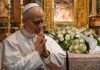




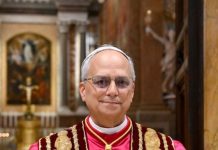











Pope Leo XIV celebrates the Jubilee of the Poor, declaring God’s eternal love for the marginalized and urging the world to break the walls of loneliness through attentive care.
Newsroom (17/11/2025 Gaudium Press ) On the 33rd Sunday in Ordinary Time, Pope Leo XIV presided over Holy Mass in St Peter’s Basilica for the ninth World Day of the Poor, celebrated this year as the Jubilee of the Poor during the 2025 Holy Year. Thousands of homeless, refugees, volunteers, and pilgrims filled the basilica and spilled into St Peter’s Square, where giant screens allowed the overflow crowd to participate.
Before processing into the basilica, the Holy Father paused at the portico to greet the faithful gathered outside with brief, spontaneous words:
“Good morning, happy Sunday! Good morning everyone, and welcome! […] The Basilica is becoming a bit small… You are part of the Church and can also follow the Mass on the maxiscreens. Participate with a lot of love, with a lot of faith, and know that we are all united in Christ.”
In his homily, Pope Leo XIV wove together the apocalyptic readings of the day with a passionate reflection on God’s preferential love for the poor and the Church’s mission to embody that love concretely.
Linking the prophecy of Malachi about the “sun of righteousness” to Christ himself, the Pope stressed that the “day of the Lord” is not only the end of history but the Kingdom breaking into the present. Even amid wars, persecutions, and personal trials, he said, believers can remain unshaken because of Jesus’ promise: “Not a hair of your head will perish” (Lk 21:18).
Turning directly to the poor and marginalized present, the Holy Father proclaimed:
“While the entire Church rejoices and exults, it is especially to you, dear brothers and sisters, that I want to proclaim the irrevocable words of the Lord Jesus himself: ‘Dilexi te, I have loved you’ (Rev 3:9). Yes, before our smallness and poverty, God looks at us like no one else and loves us with eternal love.”
He described the Church’s vocation today as becoming “mother of the poor, a place of welcome and justice,” quoting his own recent apostolic exhortation Dilexi Te.
The Pope identified loneliness as the “tragedy that cuts across” all contemporary forms of poverty—material, moral, and spiritual—particularly affecting young people. He called for an integral response that goes beyond emergency aid to foster a “culture of attention” capable of dismantling isolation wherever it appears: in families, workplaces, schools, parishes, and even the digital world.
Addressing the “globalization of helplessness” seemingly confirmed by ongoing wars, Pope Leo XIV rejected fatalism:
“The Gospel… reminds us that it is precisely in the upheavals of history that the Lord comes to save us. And today, as a Christian community, together with the poor, we must become a living sign of this salvation.”
In a direct appeal to political leaders, he insisted: “There can be no peace without justice, and the poor remind us of this in many ways, through migration as well as through their cries, which are often stifled by the myth of well-being and progress that does not take everyone into account.”
He expressed profound gratitude to charity workers and volunteers, encouraging them to remain society’s “critical conscience” and reminding them that the poor “are the very flesh of Christ and not just a sociological category.”
Concluding with an exhortation drawn from St Paul’s Second Letter to the Thessalonians, the Pope urged Christians not to withdraw into private piety but to actively transform society into “a space of fraternity and dignity for all, without exception.” He invoked the intercession of St Benedict Joseph Labre, patron of the homeless, and the Virgin Mary, whose Magnificat continues to amplify the voice of the voiceless.
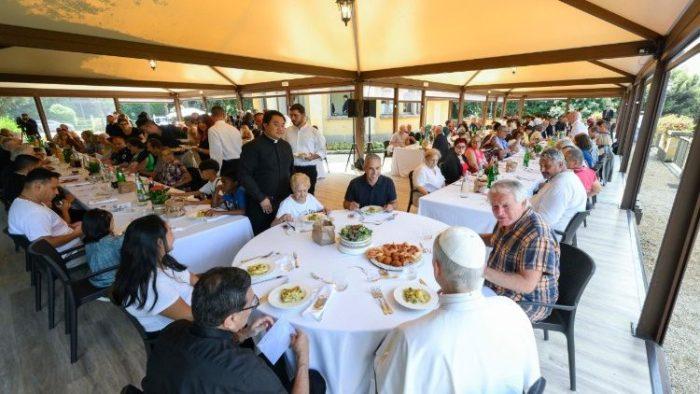
At the end of Mass, the Holy Father joined many of the poor for a festive lunch in the Paul VI Hall, continuing a tradition begun by Pope Francis. The World Day of the Poor, instituted in 2016, this year coincided with the special Jubilee of the Poor, one of several thematic jubilees scheduled throughout the 2025 Holy Year.
- Raju Hasmukh
Related Images: