












Oxford Catholics eye boost as St. John Henry Newman named church’s 38th doctor Nov. 1, sparking faith talks at historic university.
Newsroom (29/10/2025, Gaudium Press )When St. John Henry Newman is proclaimed a doctor of the church on Nov. 1, staff and students at his alma mater will be counting on a boost of confidence for Oxford’s once-excluded Catholics.
“Newman had a huge influence during his lifetime and drew a lot of people into the church,” said Alvea Fernandez, lay chaplain at Oxford University’s Catholic chaplaincy. “Seeing a relatively recent Oxford figure elevated this way now has encouraged people to talk more openly about their faith.”
Fernandez spoke with OSV News as members of the ancient university prepared to travel to Rome for the All Saints’ Day ceremony, which will see the one-time Protestant declared the Catholic Church’s 38th doctor.
She said 2025 had seen an upturn in people wishing to become Catholic or renew their faith, as well as keen interest in local sites associated with Newman’s conversion and witness.
Meanwhile, a prominent Catholic student told OSV News that St. Newman’s recognition had raised the profile of church members at the university, with a record number of Catholic first-year students admitted this October.
“Oxford University hasn’t been the most accepting of places for Catholics,” said Adam Gardner, president of the university’s Newman Society, founded as a Catholic club in 1878. “But it feels as if Oxford is becoming more Catholic, and I think this will provide another catalyst for awareness-raising.”
Born in London, St. Newman (1801-1890) studied at Oxford’s Trinity College from 1816 to 1822, later co-founding the reformist Oxford Movement while serving as vicar of St. Mary the Virgin’s university church.
After quitting his posts to become a Catholic in 1845, he founded a church and community at nearby Littlemore, producing a vast output of works that have made him one of the Christian world’s most studied figures.
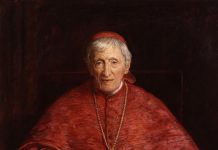
Made a cardinal in 1879 by Pope Leo XIII, St. Newman became the first English non-martyr saint in six centuries when canonized in October 2019. He has given his name to numerous schools and colleges, as well as an oratory and university in Birmingham, where he lived in later life.
Lord Neil Mendoza, provost of Oriel College — where the saint served as a fellow and became an Anglican priest — said he had been “reminded many times” of St. Newman’s “profound impact” on university life.
St. Mary the Virgin’s current vicar, Father William Lamb, told OSV News that many pilgrims were now coming to see the pulpit from which St. Newman preached his famous sermons.
“While people will want to celebrate Newman’s theological views about conscience, the role of laity and the development of doctrine, he’s also an important figure for the field of education,” Father Lamb said. “His writings will stimulate sustained reflection about what a university education can contribute to human flourishing.”
Catholics were excluded from Oxford after the 16th-century Reformation. Though a 1829 Relief Act made higher education possible, restrictions remained until recusancy laws were repealed in 1888.
The university numbers 57 beatified Catholic martyrs among its alumni, commemorated annually on Dec. 1. Its 15 saints include St. Thomas More (1478-1535), who was university chancellor, and St. Edmund Campion (1540-1581), a Jesuit fellow of St. John’s College hanged and dismembered at Tyburn in London alongside St. Ralph Sherwin.
A small chapel built by Jesuit priests became the city’s first legal Catholic place of worship in 1793, while the discreetly located Oratory Church of St. Aloysius opened in 1875. Catholics were not allowed to enroll at the university until the 1890s, with the foundation of a Catholic chaplaincy and two private Catholic study centers.
Father William Pearsall, a priest at the Jesuit-run Campion Hall, said St. Newman had “turned himself into an outcast” with his conversion but later helped Catholicism gain acceptance as “truly English” through his “scholarship and Christian character.”
Later wartime heroism by local Catholics improved the community’s profile, Father Pearsall told OSV News. The university now hosts many Catholic lecturers and professors, with Masses celebrated routinely in most college chapels.
Not everyone shares the enthusiasm at Oxford — named the world’s No. 1 university for the eighth year running in a recent survey. The university’s main website makes no mention of St. Newman’s elevation, while Trinity College notes that the saint will receive “one of the Catholic Church’s highest honors.”
Prominent Oxford Anglicans have been wary of St. Newman’s new status, aware that the saint, after deep reflection, repudiated their church’s “via media,” or middle way.
Diarmaid MacCulloch, one of Britain’s best-known Anglican church historians and now a fellow and archivist at the Catholic Campion Hall, said some colleagues have questioned Newman’s historic importance.
“Newman was a remarkably accomplished writer, with a beautiful literary style, who cleverly developed an idea of development which justified Roman Catholic doctrines not immediately obvious from early church history,” MacCulloch, Oxford’s church history professor from 1997 to 2019, told OSV News.
“While his conversion to Rome was a sensation at the time, however, I’ve never felt he said anything of particular interest or originality.”
Back among the cobbled alleyways and cloisters where the church’s latest doctor once taught and ministered, the upcoming St. Peter’s Square ceremony — to be led by Pope Leo XIV — remains a topic of conversation.
Gardner, the Newman Society president, said attendance at Mass and Catholic events in Oxford has grown steadily over the past decade, in an officially Protestant country where practicing Catholics are now thought to outnumber Anglicans by a ratio of 2-to-1.
He is enthusiastic about the increasing Catholic presence in the university’s teaching and administrative structures and hopes many more people will be brought to the faith by St. Newman’s example.
For all his skepticism, MacCulloch concedes the new prominence given to Catholicism by St. Newman’s elevation underlines an “essential aspect of Oxford past and present.”
“Newman made a genuine career sacrifice by moving to Rome, which was remedied by his canonization — it’s appropriate and good that Oxford’s Catholic traditions are being evoked this way,” the veteran historian told OSV News.
“Newman himself would no doubt have professed himself overwhelmed and humbled — but I’m sure a bit of him would have been rather pleased.”
- Raju Hasmukh with files form OSV News
Related Images: