












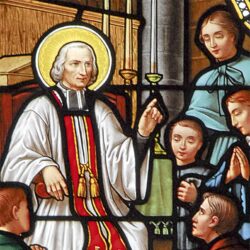
Soldier, priest by his persistence and because God willed it, he became a focus of piety and spirituality in his time — and in all times.
Editorial (08/04/2025, Gaudium Press) — Today we celebrate, among other saints, the Holy Curé of Ars, St. John Mary Vianney, a very popular saint. Many things could be said about this remarkable man — despised by many for his human limitations, yet infinitely exalted by God. Let us recount a few.
He was born in Dardilly, France, on May 8, 1786, into a peasant family. Raised during the height of the anti-Catholic agitation of the French Revolution, he had to attend religious services in secret.
He made his First Communion at age 13, in a nighttime ceremony held in a barn, where the peasants pretended they were headed to work.
A ‘deserter’ from Napoleon’s army
At times, the sentimental piety still widespread in our day hides certain aspects of the saints’ lives to make them more “palatable” to the general public — cutting out examples where God’s grace also shone. For instance, it’s not widely known that the Holy Curé of Ars was a ‘soldier,’ forcibly conscripted by the Napoleonic government. He already wanted to be a priest, but young men over 17 were required to serve in Napoleon’s bottomless pit of human lives — the army.
However, Providence spared him this service.
On his way to the barracks, he entered a church to pray and lost track of his group. He returned to report in, but fell ill during the journey and was hospitalized. When he recovered, his unit had already departed. Authorities told him to catch up with them on his own, but he met a man who claimed to be heading in the same direction and invited Vianney to come with him.
This unsolicited companion turned out to be a deserter, who led John Mary away from the battalion, making him, unknowingly, a deserter as well.
Arriving in a town, John Mary told the mayor his story. The law demanded the death penalty for deserters, but the mayor instead took him into his home, let him sleep in a barn, made him change his name, and hid him from soldiers — until the happy day a decree pardoned all draft dodgers. With that, the Holy Curé of Ars was able to return home.
“He’s not suited for studies”
After much persuasion, John Mary convinced his father to let him enter the seminary. But he was expelled because the professors said, “He’s a very good person, but not fit for studying. Nothing sticks.”
Yet John Mary did not give up. He made a pilgrimage — begging along the way — to the tomb of St. Francis Regis to ask that saint to grant him the qualities needed to become a minister of God.
A priest named Balley ran a small seminary and accepted the one who would later become a model priest admired around the world. Though Father Balley struggled with John Mary’s lack of intellectual ability, the young man’s virtue inspired him to do everything possible to help him reach the sacred priesthood. Still, when John Mary took his exams… he failed completely.
The Bishop receives him
Nonetheless, Father Balley brought his student to trusted priests, who determined that he had good moral judgment and could resolve matters of conscience. They recommended him to the bishop, who asked, “Is this young Vianney of good conduct?” They answered, “He’s excellent. A model of behavior. The least intelligent seminarian, but the holiest.” “If that’s the case,” replied the bishop, “let him be ordained. Even if he lacks knowledge, holiness will suffice — God will provide the rest.” The bishop had no idea how great a gift he was giving to the priesthood of the whole world.
Thus, John Mary was ordained a priest of Christ on August 12, 1815. For the first three years, he assisted Father Balley, who now greatly admired him. But other priests mocked the newly ordained man with “limited intelligence,” wondering to which forgotten corner of cultured France he’d be sent…
Sent to a remote town that became a beacon of Christian fervor
On February 9, 1818, he was sent to the poor and obscure village of Ars. Of its 370 inhabitants, only one man and a few women went to Sunday Mass. There were several taverns and much immorality. There, John Mary would serve as parish priest for 41 years — and, in a sense, forever.
To rekindle the town’s faith, the Curé devoted himself to prayer, penance, and firm preaching.
His penances, aimed at converting souls, are legendary.
He often ate only boiled potatoes without seasoning, prepared on Mondays to last until Thursday; then he’d cook again to last until Sunday. In sermons, he spared no words against his parishioners’ vices — exposing how the devil ensnared them.
When gossips brought complaints to the bishop, he sent an inspector. Upon return, the bishop asked, “Does Father Vianney’s preaching have any flaws?” “Yes, Your Excellency: Three. First, too long. Second, too harsh. Third, always on the same topics: sin, vice, death, judgment, hell, and heaven.” “Do the sermons have any merits?” “Yes: they move people, convert them, and help them lead holier lives.” The bishop realized that one merit outweighed all flaws.
Although he prepared extensively, he often forgot his homilies when the time came. But God would speak through him — and the spiritual fruits abounded.
His battles with the devil
The Curé of Ars was also known for intense struggles with the devil, who attacked him in many forms — throwing him from bed, once even trying to set his room on fire. In desperation, the devil is said to have declared: “Black-robed wretch, thank that one you call the Virgin Mary — if not for her, I’d have dragged you to the abyss!”
Some skeptical priests in Ars dismissed these incidents as fabrications. Vianney, without malice but aware of the reality, invited them to spend a night in his room. The moment they did, the devil’s disturbances drove them out in terror. The Curé, with a touch of humor, remarked, “The devil and I have had so many run-ins that now we’re almost like old pals…” But the truth is: he was Satan’s sworn enemy.
“Just don’t let him hear confessions…”
At his ordination, someone wrote: “Let him be a priest, but don’t let him hear confessions — he doesn’t have the knowledge for it.” This turned out to be completely false. The confessional became the very center of his luminous priesthood. People from all over France came to place their souls in the hands of the Curé of Ars, knowing that through him they heard the voice of the Holy Spirit. He spent 12 hours in the confessional during winter, 16 during summer. People booked their turn three days in advance.
A day in the life of the Curé of Ars
He rose at midnight. Rang the church bell, opened the church, and began hearing confessions — men until 6 a.m. Then prayed the breviary and celebrated Mass at 7. At 8, he was allowed by the bishop to drink a cup of milk. From 8 to 11, he confessed women. At 11, he taught catechism to all present. At noon, a light meal, a wash and shave, and visits to a youth center he funded with alms. From 1:30 to 6 p.m., more confessions. With God-given discernment, he often “read” people’s sins on their faces, offering corrections and counsel. After that, he read and went to bed.
From 1830 to 1845, around 300 people a day came to confess to him. In the final year of his life, 100,000 pilgrims visited Ars.
The bishop made him a canon, but he never wore the insignia. The government decorated him, but he refused to wear the medal. With humor, he said: “Imagine! The government decorating a coward who deserted the army…”
He died on August 4, 1859. But his memory and example will endure forever.
With information from EWTN.
Compiled by Gustavo Kralj
Related Images: