















Explore Melchizedek, the enigmatic priest‑king of Salem, in Genesis and Hebrews—foreshadowing Christ’s eternal priesthood beyond genealogy.
Newsroom (08/26/2025, Gaudium Press)
To situate ourselves in history, let us review how Melchizedek appears in Sacred Scripture—a saint commemorated today.
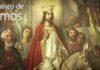
Melchizedek receives Abraham’s offering and blesses him
“When Abram returned, after defeating Chedorlaomer and the kings allied with him, the king of Sodom came out to meet him in the Valley of Shaveh (that is, the King’s Valley). Also, Melchizedek, king of Salem and priest of the Most High God, brought out bread and wine and blessed Abram, saying: ‘Blessed be Abram by God Most High, Creator of heaven and earth; and blessed be God Most High, who has delivered your enemies into your hand!’” (Genesis 14:17‑20).
As we see, this account is one of the most mysterious in the Old Testament. The figure of a king‑priest from Salem who then vanishes from Scripture sparks our curiosity and stirs our desire to know more of what little we can gather about the king of Salem.
The first detail Genesis offers is that Melchizedek was king of a land called Salem. Jewish tradition identified Salem with Jerusalem, as we see in Psalm 76:3—a linking of Salem with Zion, the ancient hill known as Jerusalem.
Colunga and García Cordero explain that “Salem could be a diminutive of Yerusalem,” since the Masoretic Yerushalayim may be an artificial expansion by rabbis to amplify the city’s name.¹
Priest and King
Regarding the name Melchizedek, it is a Canaanite name like Adonizedek, King of Jerusalem during Joshua’s time (Josh 10:1). Melchizedek, as was customary among Canaanites, was both Priest and King.²
This passage marks the first biblical occurrence of Kohen, meaning priest. Melchizedek, in his priestly role, blesses Abraham and gives thanks to God for his victory. Abraham, in gratitude and as recognition of Melchizedek’s priesthood, offers him the tithe.
Because so few details are given, biblical exegetes have drawn many spiritual lessons and allegories—culminating in St. Paul’s Letter to the Hebrews.
In Hebrews 7:1‑3, St. Paul states: “This Melchizedek, king of Salem, priest of the Most High God, who met Abraham returning from the defeat of the kings and blessed him… to whom Abraham apportioned a tenth of all the spoils, is first, by translation of his name, king of justice, and then king of Salem, which means king of peace. Without father, without mother, without genealogy, having neither beginning of days nor end of life, resembling the Son of God, he remains a priest forever.”
The Superiority of Christ’s Priesthood
St. Paul, through Hebrews, aims to highlight Christ’s infinite superiority over the Levitical priesthood. He uses the mysterious figure of Melchizedek as a didactic tool, as José María Casciaro explains: “The singular characteristics of Melchizedek make of him a ‘figure’ or ‘type’ of Christ. The parallels between Christ and Melchizedek follow rabbinic interpretive rules. This is especially evident in the phrase ‘without father, without mother, without genealogy,’ signaling Melchizedek’s eternity… Philo of Alexandria allegorically interprets Melchizedek as human reason enlightened by divine wisdom… Apocryphal literature even equates Melchizedek with Shem… Flavius Josephus calls him a ‘prince of Canaan,’ founder and high priest of Jerusalem.”²
Another lesson the Church draws—especially from Hebrews—is priestly consecration that involves leaving family and social ties. Vatican II’s teaching on priesthood says: “The figure and life of the one called to be minister of the only true God bear an aura and destiny of separation that, in a way, places him outside and above the common history of other men: sine patre, sine matre, sine genealogia, says St. Paul of the simultaneous arcane and prophetic figure of Melchizedek.”³
Christ’s Priesthood Surpasses Levitical Order
Starting at verse 11, the Apostle more clearly addresses Christ’s priesthood’s supremacy over the Levites, using Psalm 109 to underline that Jesus’ ministry “is not of carnal descent.” “It is a priesthood not ‘after the order of Aaron,’ but ‘after the order of Melchizedek.’… That means it is not like Aaron’s but like Melchizedek’s—i.e., Melchizedek-like: sharing the characteristics of Melchizedek.”⁴
(Adapted from Millon Barros – Melquizedek, Prefigure of Christ the Priest)
Compiled by Gustavo Kralj
______________________
[1] Cf COLUNGA, Alberto, O.P. ; CORDERO, Maximiliano Garcia, O.P. Bíblia Comentada I – Texto de Nácar-Colunga: Pentateuco. Madrid: Biblioteca de Autores Cristianos, 1960, p.187.
[2] CASCIARO, José Maria et al. Biblia Sagrada. Braga: Edições Theologica, 1991, p. 383-384. Tomo III (Epístolas de São Paulo: Tessalonicenses, Pastorais, Epístolas aos Hebreus, Epístolas Católicas, Apocalipse).
[3] CASCIARO, José Maria et al. Biblia Sagrada. Braga: Edições Theologica, 1991, p. 386. Tomo III (Epístolas de São Paulo: Tessalonicenses, Pastorais, Epístolas aos Hebreus, Epístolas Católicas, Apocalipse).
[4] TURRADO, Lorenzo. Biblia Comentada VI: Hechos de los Apóstoles y Epístolas paulinas. Seccion Sagradas Escrituras. Madrid: Biblioteca de Autores Cristianos, 1965, p. 485.
Related Images: