















All of us, upon being baptized, receive as an inheritance a throne in the Kingdom of Heaven; however, our faults can cause us to lose this treasure.
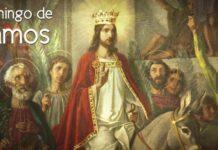
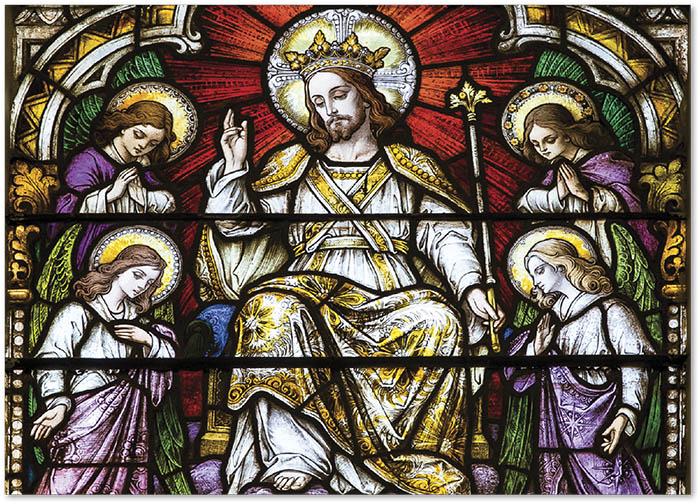
Newsroom (11/23/2025, Gaudium Press) – Today the Holy Church celebrates the Solemnity of Christ the King. How is this kingship explained? Why is Our Lord a King, and what is His reign like? Let us see what the liturgy tells us.
King Par Excellence
Our Lord is truly a King, but not in the distorted way so often promoted by the world.
In fact, human government, separated from faith, bases its authority on the force of arms, on wealth, and on men—seeking territorial conquest, the perpetuation of power, and all kinds of earthly happiness. However, over time, we see that both its foundations and its ends are illusory: weapons often turn against the very ruler; money easily passes from being a good servant to a bad master; and men, separated from the grace of God, are capable of no evil they cannot commit. In short, the happiness of a purely human government is an unrealizable utopia.
The reign of Christ is completely different. He is the Lord of the Universe, who received from the Eternal Father authority over all creatures. Furthermore, the title of King belongs to Him for several reasons:
King by Inheritance
Indeed, the psalmist says: “Ask of me, and I will make the nations your heritage, and the ends of the earth your possession” (Psalm 2:7–8). Christ is the Only-Begotten Son of God and, therefore, the universal heir (cf. Hebrews 1:2).
King as God-Man
Being God, He is also the Creator of all things and, therefore, with a simple act of will, can calm a storm, raise the dead, or perform any other phenomenon of natural or supernatural order.
However, being man, the title of King is more appropriately applied to the Son than to the other two Persons of the Most Holy Trinity, for to be King of men, it is essential to have the same nature as men. Thus, as Msgr. João affirms: “God not incarnate is Lord, God made man is King.”[1]
King by Conquest
When we buy something, we have full rights over it—especially when it cost us great effort. Well then, Christ redeemed us from the claws of the devil by shedding all His Most Precious Blood during the Passion.
King by Acclamation
By being baptized, we choose Jesus as King of our hearts and souls, and every year, at Easter, we renew this choice.
We Are Called to Be Part of His Kingdom
In His infinite mercy, God transforms us, through Baptism, from mere creatures into His children, brothers and co-heirs with Christ. We are promised a place in His Kingdom in Heaven, provided we remain united to Him through holiness.
However, due to the inner disorder caused by original sin, compounded by our faults, it is impossible for our nature to fulfill the Law and the Commandments without the supernatural help of grace—which God grants at every moment.
Yet, there is one obstacle that renders us incapable of receiving it: sin. Sin makes us insensitive to grace. This is what we see in today’s Gospel.
“One of the criminals who were hanged railed at him, saying, ‘Are you not the Christ? Save yourself and us!’ But the other rebuked him…” (Luke 23:39–40a).
In these words, we can glimpse the attitude of someone blind to the supernatural, for the bad thief cannot see the reality behind the apparent defeat and, therefore, rejects any influence of the grace our Lord offered him in those final moments.
How contrary is the reaction of the good thief. Allowing himself to be penetrated by grace, he was able to recognize his faults and weaknesses, truly repent, and accept the punishment he deserved. Thus, he could hear the Master’s wonderful words: “Truly, I say to you, today you will be with me in Paradise.” (Luke 23:43).
For this reason, today, let us ask—through Our Lady—for this grace: never to remain insensitive to the Voice of God that speaks to us each day. In this way, we too will be able to hear the promise the Savior made to the good thief.
By Artur Morais
[1] CLÁ DIAS, João Scognamiglio. O inédito sobre os Evangelhos: comentários aos Evangelhos dominicais. Vatican City–São Paulo: LEV–Instituto Lumen Sapientiæ, 2014, vol. 6, p. 490.
Related Images: