






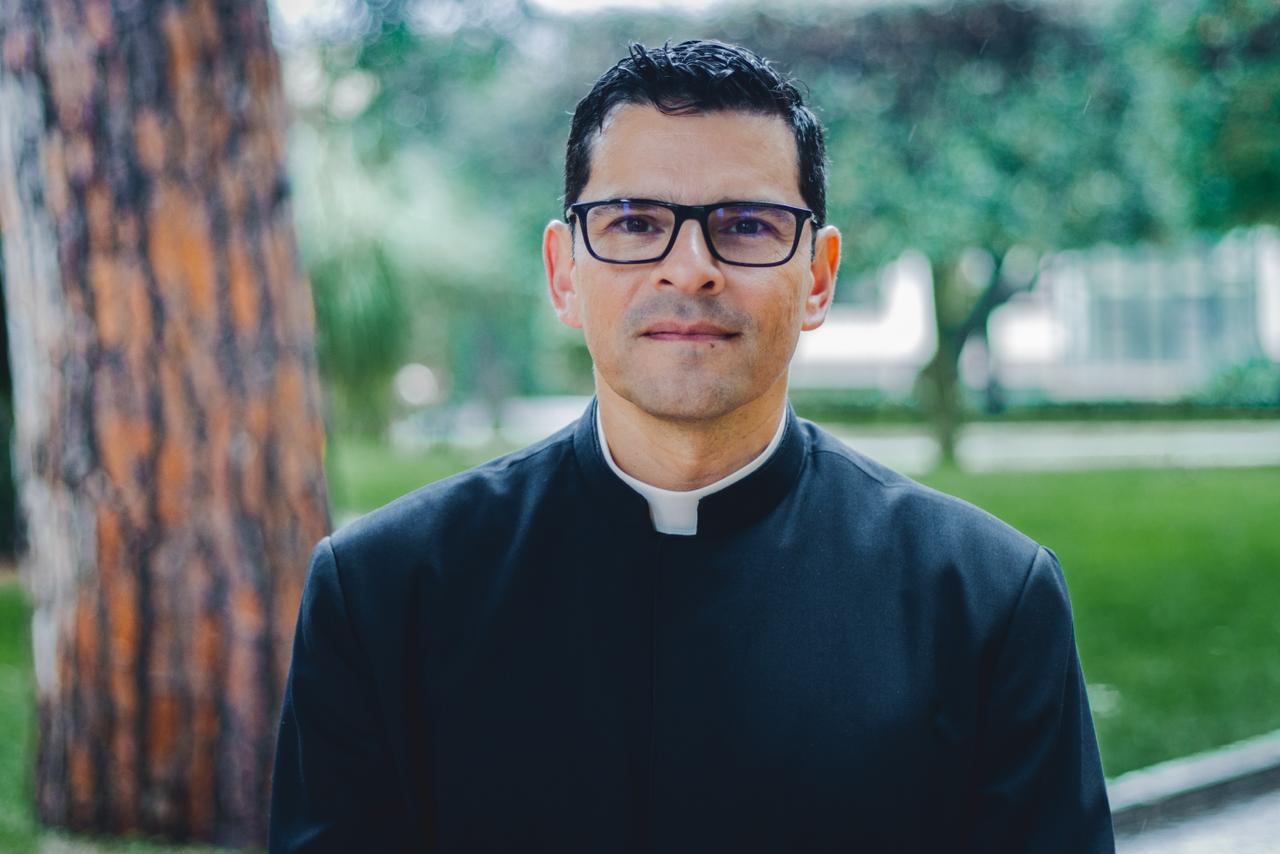
New superior general Carlos Gutiérrez López discusses the Legionaries of Christ’s 20-year journey of transparency and reform following founder Marcial Maciel’s sexual abuse crimes.
Newsroom (06/05/2026 Gaudium Press ) When Father Carlos Gutiérrez López was ordained in 2009, the Catholic world was still reeling from revelations about the founding scandal that had shaken his religious community to its core. The Legionaries of Christ, once a rising force in the modern Church, faced an existential crisis: Could a congregation survive—and ultimately thrive—after its founder was exposed as a predatory abuser who had lived a calculated double life?
Two decades later, the 51-year-old priest elected as superior general in February offers an emphatic answer. Not only have the Legionaries survived, but they have become, by many measures, a model of institutional accountability and transparency within the Church.
“Since we began to face this reality, although it has been very painful, it has also opened our eyes: there was a lot of work to be done,” Father Gutiérrez López tells ACI Prensa. “In recent years, we have worked hard to meet the standards, following the documents sent by the Church, collaborating with canonical and civil authorities.”
The Scandal That Fractured Everything
The crisis that forced this reckoning centered on Marcial Maciel, the Mexican priest who founded the Legionaries of Christ and shaped the congregation’s identity and spirituality for decades. In reality, Maciel led a secret life of depravity, sexually abusing dozens of minors over several decades while maintaining his public persona as a holy man and spiritual guide.
The Vatican confirmed the full scope of Maciel’s crimes in 2010, describing a man living “a life devoid of scruples and true religious sentiment.” Maciel died in 2008 without ever acknowledging his crimes or seeking forgiveness, even after a papal inquiry had comprehensively documented his criminal activities.
For young priests like Gutiérrez López, the revelation was shattering. “It was definitely something very intense, something that left us all very perplexed, scared, and also disappointed,” he recalls. “This meant for me a very deep process of reflection, where I had to ask myself why I was surrendering my life to God and why I was still here as well.”
A Blueprint for Institutional Reform
What set the Legionaries apart from other religious communities facing abuse scandals was their willingness—and the Vatican’s insistence—that they undertake comprehensive institutional reform. Beginning in earnest in 2006 and accelerated by the publication of the 1941-2019 Report in 2019, the congregation embarked on what Father Gutiérrez López describes as a total reimagining of how it functions.
The Holy See structured this renewal around three fundamental pillars: a redefinition of the congregation’s spiritual charism, a thorough review of how authority is exercised within the community, and a guarantee that seminarians and priests would receive proper formation.
“The Church accompanied us throughout the entire renewal process,” Father Gutiérrez López explains. “We revised the constitutions, many of the rules we had for living in the congregation, the style of apostolate we practiced… in short, it was a revision that took many years.”
The transparency initiative has become remarkable in its scope. The Legionaries now publish annual Truth, Justice and Healing Reports, subjecting 80 years of previously obscure institutional history to public scrutiny. They were pioneers in publicizing abuse cases within their ranks—an unprecedented move in consecrated religious life.
The Role of Papal Support
A critical factor in the congregation’s renewal has been consistent support from Church leadership. Pope Benedict XVI, despite condemning Maciel’s crimes, recognized that the Legionaries themselves constituted “a healthy community” composed of “young people who want to serve the faith with enthusiasm.”
This papal confidence proved crucial. Many seminarians and young priests who might otherwise have abandoned religious life entirely found in the Church’s backing a reason to persevere.
“Seeing how the Legion was responding, I thought: well, I also want to help the Church with my priesthood to help this congregation move forward, because the congregation can also contribute and give a lot to the Church in evangelization,” Father Gutiérrez López reflects on his own journey.
That encouragement continued when he met with Pope Leo XIV in February as a newly elected superior general. The Pope reiterated what he described as essential principles of authentic Church authority: it must be exercised as “fraternal and spiritual service,” not as a means of domination. He urged the Legionaries to approach all people “with a compassionate gaze,” recognizing that each encounter occurs in “a sacred space, a sacred place.”
Redefining Charism in the Aftermath
One of the central questions that has haunted the congregation—and indeed, anyone observing its renewal—is whether the charism or spiritual mission of an organization can be separated from the moral corruption of its founder.
“It’s a valid question,” Father Gutiérrez López acknowledges.
His answer reflects the Church’s own guidance. The Vatican directed the Legionaries from the beginning to examine their founding charism critically and ask what authentic contribution they could make to the Church’s mission. In that process of self-examination, a clearer picture emerged.
“I believe that charism is something we have been discovering, and it is nothing more than forming apostles to transmit the love of Christ, forming apostles and sending them to evangelize the world and help the Church in this evangelization,” he states.
This redefined mission—focused on formation of apostles and authentic evangelization rather than on hierarchical control or institutional aggrandizement—represents a fundamental departure from Maciel’s approach.
Numbers Tell a Story of Resilience and Growth
Despite the profound wounds of the past, the congregation’s statistics reveal a community that has not merely survived but continues to attract new vocations. As of December 31 of last year, the Legionaries of Christ counted 1,327 members worldwide, with approximately 250 junior seminarians currently in formation at vocational centers.
These numbers take on added significance when one considers the broader context. Many religious communities in the developed world have experienced precipitous declines in vocations. The fact that the Legionaries continue to attract young men willing to commit their lives to religious celibacy—after such a public scandal—speaks to something profound about institutional healing.
The congregation’s broader spiritual family, known as Regnum Christi, extends this reach considerably. It includes 479 consecrated women in 53 communities worldwide and encompasses an extensive educational network: 139 schools and 14 universities educating 153,219 students across multiple continents.
The Priest-Engineer’s Vision
Father Gutiérrez López brings unusual credentials to his leadership role. Trained not only in theology and philosophy at the Pontifical Athenaeum Regina Apostolorum but also holding degrees in Industrial and Systems Engineering from the Monterrey Institute of Technology and a master’s degree in Psychology from Divine Mercy University, he represents a new generation of Church leadership combining spiritual formation with technical and psychological expertise.
His international experience—ministering in Chile, Italy, Colombia, Venezuela, and Mexico—has given him direct exposure to the diverse contexts in which the Legionaries operate. Most recently, as territorial director for northern Mexico, he worked in a region marked by severe violence, poverty, and the devastating effects of organized crime and migration.
In that context, the Legionaries maintain both private schools in urban centers and a network of Mano Amiga (Helping Hand) schools serving impoverished families. These institutions aim to provide not merely education but what Father Gutiérrez López describes as “values education” designed to help young people transform their social environments.
Protection Standards and Professional Oversight
One of the most concrete measures the Legionaries have implemented involves the systematic application of child protection standards across all 23 countries where they operate. Rather than relying solely on priests to monitor these standards—an approach that historically enabled abuse—the congregation now maintains professional teams of psychologists, lawyers, and other specialists.
“In recent years, we have been very rigorous in applying these norms, refining them so that we can live them fully,” Father Gutiérrez López states. “We need specialists, psychologists, lawyers… in short, to help us take the fulfillment of these norms seriously.”
This professionalization of safeguarding represents a significant shift in institutional culture. It acknowledges what the Maciel case so catastrophically demonstrated: that internal monitoring systems alone are insufficient when authority structures lack proper checks and balances.
Authority Reimagined
Throughout his comments, Father Gutiérrez López repeatedly emphasizes a transformed understanding of what religious authority means. Drawing on his own experience as a superior and provincial director, he articulates a model fundamentally at odds with Maciel’s autocratic control.
“To my brothers, I render a service,” he explains. “What they share with me is something sacred and I have to respect that sacredness.”
This language of service and sacred respect stands in sharp contrast to the descriptions of Maciel’s abuse of authority—his manipulation of consciences, his exploitation of the obedience vowed by his followers, his cultivation of an almost cultic veneration of his person.
The Question of Redemption
Whether institutional redemption is truly possible remains an open question. The Legionaries of Christ cannot undo the suffering inflicted by Marcial Maciel or erase decades of institutional dysfunction. The victims of abuse carry wounds that no organizational restructuring can fully heal.
Yet the congregation’s approach over the past 20 years suggests that redemption—understood not as forgetting or minimizing past harm, but as sustained commitment to transparency, accountability, and genuine reform—may be achievable.
“The founder definitely stopped being a spiritual and moral reference for us,” Father Gutiérrez López observes. “And for me, that reference has always been our Lord Jesus Christ, whom we seek to imitate, with whom we also seek to have that personal relationship.”
With Pope Leo XIV’s encouragement, the newly elected superior general has been tasked with continuing the congregation’s renewal while extending its evangelical service, with particular attention to what the Church calls “existential peripheries”—the margins of society where human suffering is greatest.
Whether the Legionaries of Christ can fully transcend their founder’s legacy remains to be seen. But their 20-year commitment to accountability and reform offers at least one detailed answer to the question posed at the outset: Yes, a religious congregation can survive and be transformed after such a crisis. But only through sustained effort, genuine institutional change, and unwavering commitment to transparency and the protection of the vulnerable.
- Raju Hasmukh with files from ACI Digital
Related Images:


