






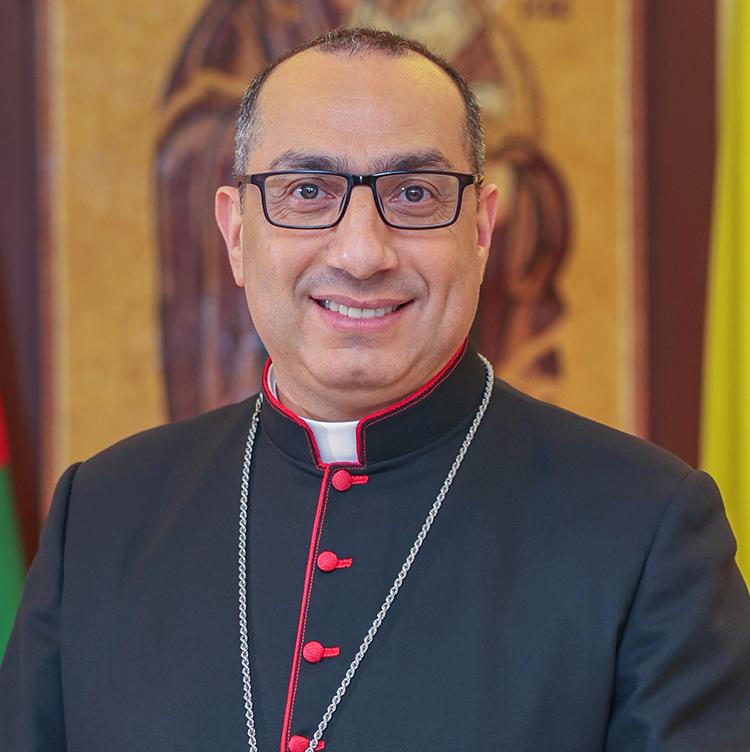
Bishop Iyad Twal urges mutual respect among faiths, stressing coexistence as the path to peace in the Middle East during Baptism of the Lord Mass.
Newsroom (10/01/2026 Gaudium Press ) Standing at the banks of the Jordan River, where Scripture places the baptism of Jesus, Bishop Iyad Twal, the Latin Patriarchal Vicar of Jordan, delivered a message that stretched beyond liturgy. Speaking to Vatican News during the celebration of the Feast of the Baptism of the Lord at the Church of the Baptism site in Bethany Beyond the Jordan, the bishop emphasized that peace in the Middle East cannot be achieved by clinging to divisions—religious, cultural, or political—but through genuine respect for human dignity and shared belonging.
“It’s not easy to reach peace,” he said, “but it is possible if we have the will to do so—if we stop focusing only on what makes us different.”
The celebration drew pilgrims and parishioners from across Jordan, creating a mosaic of the country’s Christian presence—from the Latin parishes in the north to Catholic communities in the southern towns. For Bishop Twal, the annual gathering was not merely a religious observance but an affirmation of rootedness. “Praying together means we belong to this land, to the Holy Land,” he said. “We are part of our community, our people, and our nation.”
Faith and Coexistence in the Hashemite Kingdom
In Jordan, where Muslims form the majority, the Christian minority has long enjoyed relative peace and acceptance. Bishop Twal sees this as a testament to the culture of hospitality and mutual respect championed by the Hashemite royal family. “In Jordan, we have a culture of accepting each other,” he noted. “The Hashemite family, thanks to the King and his leadership, continues to be a sign of unity for all Jordanians.”
This spirit of coexistence, he added, is cultivated through education and community engagement. Catholic schools and parishes, he said, play a vital role in nurturing dialogue among young people of different faiths. “We are trying through our schools and our parishes to keep this example of coexistence and witness alive,” the bishop explained.
Building Bridges Through Faith
Despite being a small community, the Catholic Church in Jordan has a wide-reaching impact. Bishop Twal highlighted the diversity within the Church itself—Latin, Maronite, Melkite, Syrian, and Armenian Catholics all live and worship together. This diversity, he pointed out, “is a sign of the universality of the Church in Jordan.”
Through its extensive network of schools and a university, the Catholic Church provides education and service regardless of religious affiliation or economic background. “Our mission,” Bishop Twal said, “is to build bridges with everyone. We might be small in number in Jordan, but we are part of a global Church that carries a great responsibility.”
He extended an open invitation to Christians worldwide to visit Jordan and witness firsthand what peaceful coexistence looks like in practice. “We invite our brothers and sisters to join us,” he said. “Together, we can show what it means to be a Catholic Church—in Jordan and everywhere.”
A Message for the Middle East
As conflicts, displacement, and sectarian tensions continue to challenge the region, Bishop Twal’s message resounds as both a hope and a warning. The path to peace, he insists, begins in the human heart—with the ability to recognize the face of God in the other, even when beliefs diverge.
“God’s love is for everyone,” he reminded the faithful gathered at the river. “When we focus on that truth, not on our divisions, we can live together in peace.”
- Raju Hasmukh with files from Vatican News
Related Images:


