













Several centuries ago, humanity gathered everything it had and left its father’s affection behind, squandering its possessions and living dissolutely.
Newsdesk (10/11/2025 7:19, Gaudium Press) Just as a small drop of water can reflect within it the image of the sun, so too does the parable of the Prodigal Son reveal the overflowing goodness of God when a sinner turns to Him, repenting of his faults.
On the other hand, the attitude of the older brother symbolizes certain souls who, faced with a great manifestation of mercy, close themselves off, unable to understand the beauty of forgiveness.
The contrast between two forms of justice
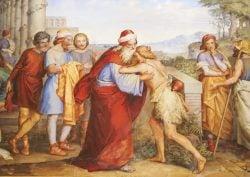
The father’s reactions could not have been more moving in terms of kindness and tenderness. He had certainly longed to see his son again and prayed for him. When he saw him from a distance, he was filled with affectionate compassion and, despite his age, he went out to meet him without delay, quite the contrary, “running.” Let us remember where that poor wretch of a son had come from! From pigsties, where he competed with the pigs for food. He presented himself, therefore, as a true beggar, unclean, totally unfit to be embraced. However, the father threw himself around his neck and covered him with kisses.
At a certain point in the confession of his faults, the father interrupts him, clearly not desiring to hear it all, and ordered the servants to hurry and bring him the richest clothes, sandals, and ring.
“Then the son said to him, ‘Father, I have sinned against heaven and before you; I am no longer worthy to be called your son.’ But the father said to his slaves, ‘Quickly, bring out a robe—the best one—and put it on him; put a ring on his finger and sandals on his feet” (Lk 15:21-22)
Symbol of the Sacrament of Reconciliation
How much symbolism there is in this short verse!
The son, besides having long forgotten his father, had squandered his possessions. It is an image of the effect of sin on the soul of a baptized person: it strips them of their merits, gifts, and virtues; it deprives them of their beautiful supernatural garments; above all, it robs them of the immeasurable privilege of divine adoption and returns them to the state of a mere creature, still stained by the mire of the offense against God. However, by confessing his miseries in the confessional and receiving absolution, man is clothed in the most precious fabrics of reconciliation, the sandals of merit are returned to him, and the ring of the Son of God is placed back on his finger.
The father does not want to see him marked with any signs that might remind him of his previous sinful life, and, as if these gestures were not enough, he orders a feast to be prepared, killing a “’fatted calf”—thus indicating the solemn nature of the banquet, because normally a lamb or a goat would be killed.
The reason given for such a celebration is the same as that given by Jesus: “there will be more joy in heaven over one sinner who repents than over ninety-nine righteous persons who need no repentance” (Luke 15:7). The son was lost, the son was dead, and the joy of that reunion was incalculable.
This is the perfect image of Divine Justice, made entirely of mercy. Let us now look at the metaphorical reproduction of “worldly justice” in the reactions of the older son.
“Then he became angry and refused to go in. His father came out and began to plead with him. But he answered his father, ‘Listen! For all these years I have been working like a slave for you, and I have never disobeyed your command; yet you have never given me even a young goat so that I might celebrate with my friends. But when this son of yours came back, who has devoured your property with prostitutes, you killed the fatted calf for him!’ Then the father said to him, ‘Son, you are always with me, and all that is mine is yours. But we had to celebrate and rejoice, because this brother of yours was dead and has come to life; he was lost and has been found.'”(LK 15:28-32).
Pride, envy, and anger in the reaction of the firstborn
Verse 25 offers us other elements of the pomp of that great solemnity: the choral and instrumental music heard by the firstborn upon returning from the field. Such displays of joy were so unusual in his home that he was afraid to enter the main rooms, certainly because of his country clothes, and perhaps because he thought the event was too grand, so he preferred to ask one of the servants what was the reason for such exuberant euphoria. No other reason would have provoked such indignant anger in him. Let us summarize verses 28 to 32 of the parable:
The firstborn was a good person, according to the narrative, because he lived constantly with his father and left everything he owned in his hands. He had never disobeyed in the slightest during his many years of service. He was, therefore, very disciplined and faithful.
However, his reaction to the prodigal son’s conversion did not stem from any of the qualities mentioned above. On the contrary, it was motivated by pride, envy, and anger, as we often find in our social relationships.
Arrogance: When stating the reasons why he refused to participate in the celebrations, he begins by praising himself, establishing his virtue in the Law by which his conduct should be judged by his father. This is precisely the criterion of the proud: he sits on God’s throne and takes on the role of the Law and of the Judge.
In his outburst of vanity, he fails to realize his father’s great joy at the return of his prodigal son. The father knew perfectly well what kind of places his younger son had been frequenting, but this was the moment to forget everything. Pride clouds one’s balanced and harmonious view of events and, therefore, leads the firstborn to hurt the heart of his father by reminding him of his brother’s moral transgressions.
Envy: This vice is evident in the comparison: he has a fatted calf, while I don’t even have a goat. This is another common custom in the world, since the time of Cain’s murder of Abel.
Anger: “He was indignant…” His virtues received the honorable invitation to reach the heroic degree with the news of his brother’s return, but the externalization of his anger tarnished these human qualities that could have been supernaturalized.
In summary, the father, seeing his son in the distance, runs to meet him with joy. The brother, bitter and sad, refuses to take part in the banquet. The father, overcome with emotion, embraces him and covers him with kisses. The firstborn is filled with indignation and refuses to come in.
The older son sins by lacking charity, judging the celebration for his brother’s return to be unjust. Furthermore, he sins against the respect due to his father, making clear through his behavior how much he reproaches his father for everything he has done regarding his younger brother. Finally, he also sins by disobeying his father’s decision that everyone should participate in the banquet.
Obviously, the younger son’s faults are more serious. But there is something repugnant about the vices practiced by the older son. In one, the weakness of the will is apparent; in the other, a wickedness of the heart.
Conclusion
Which of the sons in the metaphor could humanity be likened to in this new millennium? Is it walking down the path of the prodigal son or that of the firstborn?
Undoubtedly, several centuries ago, humanity gathered everything it had and left its father’s affection behind, squandering its possessions and living dissolutely.
After squandering everything and suffering great hunger, will it eat the acorns of the pigs and long for its father’s house? Will it return deeply repentant and full of good intentions? And what of each one of us?
The future will answer us, and if the parable symbolizes events to come, let us understand the Father’s goodness in wanting to forgive, and the fate of those who refuse to come into harmony with Him.
Extracted, with adaptations, from: Msgr. João S. CLÁ DIAS, . New Insights on the Gospels, Volume V.
The post Justice and Mercy: How would We respond if put to the Test? appeared first on Gaudium Press.
Compiled by Roberta MacEwan
Related Images: