



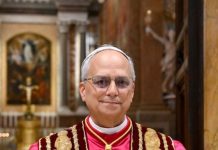












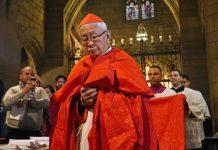

Cardinal Pierbattista Pizzaballa has underscored Pope Leo XIV’s appeals for peace and to stop proliferation of weapons.
Newsdesk (17/05/2025 09:10, Gaudium Press) As US President Donald Trump’s visit to Gulf Arab countries, ending May 16, brought “the largest defense cooperation agreement” Washington has ever done, according to the White House fact sheet, Catholic leadership in the region expressed its concern to resolve long-standing conflicts, particularly in the Middle East, peacefully.
The United States signed agreements with Saudi Arabia to provide nearly $142 billion of air and missile defense systems, air force and space advancement, maritime security and communications. Qatar and the U.S. agreed on a $1.2 trillion “economic exchange,” while Saudi Arabia promised to invest $600 billion in the U.S.
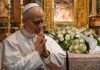
Cardinal Pierbattista Pizzaballa, the Latin patriarch of Jerusalem, has underscored Pope Leo XIV’s appeals for peace and to stop the proliferation of weapons, as the newly installed pontiff has taken up his Petrine ministry.
“This is what distinguishes it on the international scene. The Holy See has no vested interests. Its only interest is the good of the human family,” said Cardinal Pizzaballa, in remarks to the Italian newspaper Avvenire.
“If I think of our context, that of the Holy Land, I see the Holy See with a facilitator role. Because no solution can be found without the involvement of multiple actors: from local to international ones,” he said.
Both Pope Leo and Cardinal Pizzaballa called attention to the urgency of ending the conflict in Gaza.
“I am deeply saddened by what is happening in the Gaza Strip,” Pope Leo said in his first “Regina Coeli” address May 11. “May there be an immediate ceasefire! Let humanitarian aid be provided to the stricken civil population, and let all the hostages be freed,” the pope said.
“Now the visit of US President Donald Trump to the Middle East is taking place. I hope that the trip will lead to a change in the war in Gaza and beyond,” Cardinal Pizzaballa said.
“The glimmers of hope, however, seem few at the moment. I hope that the end of the war is not so far away,” because “if it were to continue, it would be a tragedy from a humanitarian point of view, in addition to being a completely morally unacceptable fact,” Cardinal Pizzaballa told Avvenire, adding that the situation in the enclave is beyond dramatic.
“Food is scarce. Women, men, families no longer know how to make it to the evening. Children are abandoned to themselves and have no opportunity for education. Practically the entire population is displaced. The bombings sow death and destruction. And they add victims to the thousands of victims that have already occurred,” he said.
The Israeli military has been preparing for a major offensive in the Gaza Strip, which officials said would be launched if no hostage deal is reached with Hamas by the end of Trump’s visit to the region May 13-16, as reported by The Times of Israel.
One in five people in Gaza face starvation, a UN-backed report warned, as Israel’s months-long blockade of humanitarian aid continues. Gaza’s entire population of 2.1 million is experiencing “high levels of acute food security” and is at “high risk” of famine, the most severe type of hunger crisis, the Integrated Food Security Phase Classification report noted.
The World Health Organization called the situation in which food and medical supplies have been stopped “one of the world’s worst hunger crises, unfolding in real time.”
Both Pope Francis and Pope Leo spoke of “martyr” churches in war zones and Pope Leo thanked Christians who do not abandon difficult lands, such as the Middle East, during his first addresses as pope.
“Visiting the parishes of the patriarchate, I certainly notice tiredness, but also a lot of commitment and desire to move forward,” Cardinal Pizzaballa said.
- Raju Hasmkh with files from UCAN news
Related Images: