






















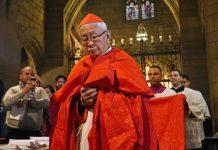


About 10,000 people joined Paris’s March for Life as France’s Senate debates legalizing euthanasia and assisted suicide amid ethical and social tensions.
Newsroom (20/01/2026 Gaudium Press) Around 10,000 people filled the streets of Paris on Sunday for the 2026 edition of the March for Life (“Marche Pour La Vie”), a yearly event that took on sharper political significance this winter. The demonstration unfolded just days after the French Senate began deliberations on a bill that would legalize euthanasia and assisted suicide—legislation that has divided politicians, medical professionals, and faith leaders alike.
Since January 12, senators have been reviewing the contentious measure first passed by the National Assembly last May, opening the door to “assisted dying.” President Emmanuel Macron has championed the bill as a key social reform, calling it a step toward compassion and autonomy at the end of life. Yet for thousands of French citizens gathered at Vauban Square, the law represents something else entirely: a moral line that should not be crossed.
“True Dignity Lies in Accompaniment”
Organizers of the March for Life framed the rally not as a rejection of compassion, but as a defense of what they describe as authentic human dignity. “True human dignity lies in accompanying the most vulnerable, not in the social and medical offering of euthanasia or abortion,” they stated in their official communiqué.
The marchers, many carrying banners in bright colors and messages celebrating life, sought to draw attention to what they called a “deep social wound” within France’s demographic and ethical landscape. Recent data from the National Institute of Statistics and Economic Studies (INSEE) underscored their point: the nation’s birth rate fell again in 2024—from 677,803 births in 2023 to just 663,000—while the number of abortions rose to 251,270.
Beyond statistics, the demonstrators warned of a shift in values. Over three years of parliamentary debate, they argued, France has drifted toward what they termed “a culture of death,” where illness, age, or disability may increasingly determine one’s perceived worth.
Fears of Pressure on the Vulnerable
Participants voiced deep concern about the broader implications of the assisted dying proposal. “In some countries, euthanasia is already being used as a form of blackmail, offered as a ‘free’ alternative to prohibitively expensive care,” one statement read. Advocates for the march stressed that financial constraints must never dictate life-or-death decisions, warning that the elderly, disabled, and terminally ill could face new forms of subtle coercion if the law passes.
The event’s central manifesto criticized the moral reasoning behind the bill, insisting that “human dignity does not depend on health, age, or social perception, but is intrinsic to the human condition.” Legislators, it warned, “must never presume to decide which lives are worth living.”
Palliative Care at the Center of the Debate
At the policy level, the debate has also reignited questions about palliative care—the system of medical and emotional support for the dying that activists say remains underfunded and inconsistent across France. While government officials argue that euthanasia and palliative care can coexist, march organizers rejected that position flatly. They fear that legalizing assisted dying would inevitably drain resources from palliative programs, particularly under economic strain.
In their view, the humane alternative lies in expanding access to care and ensuring that health workers can act according to conscience. Among the key demands voiced during the rally were the creation of a national palliative care plan and the legal guarantee of conscientious objection for all medical staff.
A Joyful March in a Serious Context
Despite the gravity of the issues, the march maintained an unusually positive and family-oriented atmosphere. Families, young people, and religious groups walked side by side through the cold January air, punctuating solemn speeches with songs and chants celebrating life. Bishop Dominique Rey, Bishop Emeritus of Fréjus-Toulon, joined public figures and civic leaders in the procession, calling for “a renewal of compassion that does not betray life itself.”
For some, the mobilization was a direct political gesture meant to influence senators ahead of the scheduled vote on January 28. For others, it marked part of a longer cultural struggle over how France understands life, suffering, and solidarity.
As the National Assembly prepares to reconsider the bill in February, the March for Life has once again brought France face to face with a profound question: how should a modern democracy define human dignity—and who gets to decide its limits?
- Raju Hasmukh with files from ACI Prensa
Related Images: