





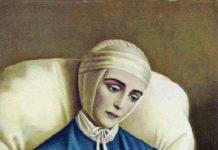










On Remembrance Day, the untold story of St. Thérèse of Lisieux: how the young Carmelite who died in 1897 became the most beloved saint of WWI soldiers.
Newsroom (11/11/2025 Gaudium Press ) At the eleventh hour of the eleventh day of the eleventh month, when Europe fell silent in 1918 to mark the end of the war that devoured an entire generation, a 24-year-old Carmelite nun who had been dead for twenty-one years was nevertheless present in the mud of Flanders, the forests of Verdun, and the shell-cratered hills of the Somme.
St. Thérèse of the Child Jesus and of the Holy Face never heard an artillery barrage. She never smelled cordite or felt the freezing water of a flooded trench. Yet from the first months of the Great War, French, Belgian, British, and even some German soldiers carried her photograph into battle as confidently as they carried their rifles.
The archives of the Carmel of Lisieux contain one of the most moving collections of wartime correspondence ever preserved. Hundreds of letters—written in pencil on scraps of paper, on the backs of field postcards, sometimes in blood-stained envelopes—poured into the Norman convent between 1914 and 1918. Soldiers who had never set foot in Lisieux addressed the young nun they called “my little sister” or “my guardian angel” with an intimacy usually reserved for mothers and sweethearts.
“It is to your little sister Thérèse that I owe my life,” wrote one poilu in 1916. “A bullet went clean through my greatcoat but did not touch me. I had her picture over my heart.”
Another soldier sent the Carmel his Croix de Guerre, explaining that the decoration no longer belonged to him: “I only carried it because she carried me.”
Military medals, regimental banners, fragments of shell casings transformed into votive offerings—each arrived with a brief, often barely literate note of gratitude. Giving away hard-won decorations was almost unheard of among fighting men; that they surrendered them willingly to a cloistered nun reveals the depth of their conviction.
Historian Sébastien Vogt, who has studied the Lisieux archives exhaustively, discovered that one French artillery regiment went so far as to christen a 1.9-ton 155mm howitzer “Battery Sister Thérèse of the Child Jesus” after the gun rolled over a sleeping gunner in 1917 without crushing him. The crew insisted the saint had lifted the weapon.
The testimonies range from the quietly miraculous to the openly supernatural.
Captain Pierre Mestre wrote that while praying before Thérèse’s image he heard a clear interior voice: “You will be wounded before the end of the month, but far less seriously if you accept this sacrifice generously for God.” He was indeed wounded weeks later—by shrapnel that should have killed him—but survived with only a flesh wound to the thigh.

Irish Sergeant Michael Mulqueen of the Royal Dublin Fusiliers told the Carmel: “During a terrible bombardment I heard a gentle voice say, ‘Take my relic.’ I pulled her little picture from my pocket, and though shells burst all around, I alone remained untouched.”
Long before the war, Thérèse had confided to her fellow nuns in May 1897, three months before her death: “After my death I will let fall a shower of roses. I want to spend my heaven doing good on earth.” She added with characteristic boldness: “I will torment God so much with my requests that even if He refuses at first, my persistence will force Him to say yes. It’s in the Gospel.”
The soldiers of 1914–1918 believed they had received that promised shower of roses in the form of spared lives, sudden conversions, and an inexplicable peace in the midst of industrial slaughter.
On this Remembrance Day, while nations honour the known and unknown soldiers who fell, millions of Catholics also quietly remember the cloistered virgin who, from the silence of her convent grave, became one of the war’s most powerful and tender presences.
- Raju Hasmukh with files from Tribune Chretienne
Related Images: