

















Three Hong Kong activists go on trial for organizing banned Tiananmen vigils, facing up to 10 years under the city’s national security law.
Newsroom (22/01/2026 Gaudium Press) The national security trial of three Hong Kong activists who once organized the city’s annual Tiananmen Square vigils opened on January 22, marking another milestone in Beijing’s far-reaching control over the territory’s pro-democracy movement. The trio — Chow Hang-tung, Lee Cheuk-yan, and Albert Ho — stand accused of “incitement to subversion,” a charge that carries up to 10 years in prison.
The case centers on their leadership of the Hong Kong Alliance in Support of Patriotic Democratic Movements of China, which for more than three decades held candlelight vigils mourning the victims of Beijing’s deadly crackdown on student-led protests in Tiananmen Square on June 4, 1989. Those gatherings, once a symbol of the city’s relative freedoms, have been banned since 2020, the year Beijing imposed its sweeping national security law on Hong Kong in response to the massive pro-democracy demonstrations of 2019.
The Alliance was disbanded in 2021 after its leaders were arrested, accused of subverting state power by calling for an “end to one-party rule” in China. Prosecutors argue that message undermined Beijing’s authority and thus violated the security law. The trial, which will be held without a jury, is expected to last 75 days.
A Trial Amid Tight Security
On the morning of January 22, crowds gathered outside the courtroom despite the winter chill. About 70 people queued for seats in the public gallery while police maintained a heavy presence nearby. Inside, two of the defendants — Chow and Lee — remained defiant, pleading not guilty. Both have been behind bars since 2021. The third, Albert Ho, entered a guilty plea.
Retiree Simon Ng, waiting in line to observe the proceedings, said the Alliance’s vigils once represented Hong Kong’s distinct political identity. “They were honorable,” he said, describing the activists’ advocacy for China’s democratization as a reflection of values “fundamentally different from that of mainland China.”
Court documents made public a day before the trial outlined prosecution evidence, including company records, online materials, video clips of speeches, and artifacts seized from the now-closed Tiananmen museum that the Alliance once operated.
Global Rights Groups Speak Out
Human rights organizations quickly criticized the proceedings. Amnesty International said the case was “not about national security — it is about rewriting history.” Human Rights Watch urged authorities to drop the charges and release the activists, calling the case emblematic of shrinking freedoms in Hong Kong.
Yet officials maintain the prosecution is lawful, asserting it upholds human rights protections within the framework of the city’s new security regime. A three-judge panel dismissed Chow’s application to quash the case, writing in a preliminary ruling that “the court will not allow the trial to become, as [Chow] said, a tool for political suppression.”
The Legacy of the Vigils
Founded in May 1989, the Hong Kong Alliance was originally established to support the Beijing students demonstrating against corruption and in favor of democratic reforms. When the Chinese government sent tanks and troops to crush the movement the following month, killing hundreds or possibly thousands, the Alliance took on a new role: keeping that memory alive.
For over 30 years, its June 4 vigils in Victoria Park provided a rare space in Chinese territory where people could publicly grieve and call for justice. The sight of tens of thousands of flickering candles became a defining image of Hong Kong’s civil society.
Tiananmen survivor Zhou Fengsuo, now based in the United States, said he was “deeply concerned” for the three defendants. “They represent the conscience of a free Hong Kong that was destroyed,” he said.
Authorities have tightened control over such expressions of dissent. Last year, courts barred overseas witnesses from testifying remotely in national security cases. In 2021, the Alliance had refused to submit membership and financial details to national security police — a stance that triggered additional criminal charges.
Former member Tang Ngok-kwan, involved in that earlier case, said he hoped the current proceedings might nonetheless prompt reflection. “By having a venue to debate China’s constitutional development, I hope the case will have an impact on the future,” he said.
A Symbolic Test of Hong Kong’s Autonomy
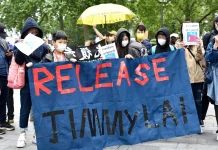
The trial follows last month’s conviction of Jimmy Lai, the media tycoon behind the now-defunct Apple Daily newspaper, who was found guilty of conspiring to commit foreign collusion — a verdict that drew widespread international condemnation. In response, the city’s Chief Justice defended the judiciary on January 19, insisting that judges act solely “on the law and the evidence, not with any underlying matters of politics.”
Still, for many observers, the case against Chow, Lee, and Ho highlights the profound transformation of Hong Kong’s civic freedoms since 2020. Once a beacon of open expression, the city now stands as a testing ground for China’s evolving definition of national security — and the limits of dissent within its sovereignty.
- Raju Hasmukh with files from UCA News
Related Images: