















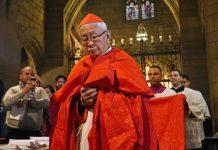


Hiroshima survivor Tanaka Katsuko, 87, shares atomic horror at Rome peace summit with bishop, urging nuclear abolition as moral duty for humanity’s survival.
Newsroom (28/10/2025, Gaudium Press ) A blinding flash, a shout of “Enemy plane!”, and then whiteness. Tanaka Katsuko was six years old when the atomic bomb fell on Hiroshima on 6 August 1945. “My eyes went white and I couldn’t see anything,” she recalled. “I had a bitter, grainy taste in my mouth.”
Now 87, one of the last surviving hibakusha, she spoke Tuesday at the Community of Sant’Egidio’s international peace summit in the auditorium of Rome’s MAXXI museum. The panel, titled “The Forgotten Danger: For a World Without Nuclear Weapons,” brought together survivors, clergy, activists and scholars to confront a threat that still looms over 12,000 warheads worldwide.
Regaining her sight through a crack in the debris, Tanaka saw a patch of blue sky. “That memory sustained me through every difficulty,” she said. The image became the seed of her life’s work: enamel murals that evoke the trauma, and a mission to declare that “nuclear weapons and humanity cannot coexist.”
Her daughter, seated beside her in Rome, said she feels the same responsibility to carry the message forward.
Andrea Bartoli, president of the Sant’Egidio Foundation for Peace and Dialogue and moderator of the session, called the mother-and-daughter testimony “a bridge between those no longer with us and those who remain.” He urged the conversion of arsenals into energy, likening Tanaka’s blue sky to the United Nations’ emblem — a symbol born from the ashes of 1945.
“Peace begins in the heart of each of us,” Tanaka said. “We are all crew members aboard the ship Earth.” Despite the trauma, she added, “I continue to believe in human wisdom.”
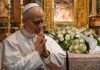
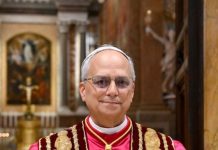
Bishop Alexis Mitsuru Shirahama of Hiroshima, speaking in Japanese, marked the approaching 80th anniversary of the bombings of Hiroshima and Nagasaki. “We are moving to a generation that does not know the horrors of war and the atomic bomb,” he warned.
Quoting Pope Francis’s 2019 visit to the Hiroshima Peace Memorial — where the pontiff called nuclear weapons “immoral” — the bishop stressed remembrance, shared journeys and protection. Yet he painted a grim picture: nuclear powers are “turning their backs” on the 1970 Non-Proliferation Treaty (NPT), signed by 191 states, and the 2021 Treaty on the Prohibition of Nuclear Weapons (TPNW), ratified by more than 90.
“If the threat materialised today, the impact would be incalculable,” Shirahama said. He cited a hibakusha who told him: focus not on the past but on “the period of humanity’s extinction due to nuclear weapons.”
Religious leaders, he argued, must serve as “promoters of peace” and “bridges.” Time is short, so “small steps” are urgent. The dioceses of Hiroshima and Nagasaki have launched a fund for abolition, partnering with the archdioceses of Seattle and Santa Fe — cities linked to the Los Alamos tests. A five-year project will also support hibakusha and the TPNW.
“With fewer survivors left, we must engage the new generations in concrete actions,” Shirahama told AsiaNews after the panel. “Material progress is not matched by spiritual evolution. We must rediscover human spirituality so humanity is not completely destroyed.”
Susi Snyder of the International Campaign to Abolish Nuclear Weapons (ICAN), recipient of the 2017 Nobel Peace Prize, challenged the logic of deterrence. “It is not demonstrable, and the possibility of failure is real,” she said. Normalising the threat, she warned, is already underway. A robust legal framework is the only path to elimination: “Once the button is pressed, there is no going back.”
Sociologist Fabrizio Battistelli closed the session by noting the 2024 Nobel Peace Prize awarded to Nihon Hidankyo, the Japanese hibakusha organisation. The honour, he said, is a timely invitation to re-examine a nuclear taboo that persists amid the wars in Ukraine and Palestine.
In a world that treats apocalypse as deterrent, the voices in Rome insisted the danger is not forgotten — only ignored.
- Raju Hasmukh with files from Asianews.it
Related Images: