






Greenlanders express worry, pride, and faith as Trump’s renewed Greenland acquisition plan raises sovereignty fears and calls for peace.
Newsroom (08/01/2026 Gaudium Press ) The Trump administration’s revived push to acquire Greenland — publicly confirmed this week as a potential U.S. foreign policy goal — has reignited deep concerns among Greenland’s residents. From shop counters to church pews in the capital city of Nuuk, conversations are tinged with anxiety but also a quiet resolve to protect identity and sovereignty.
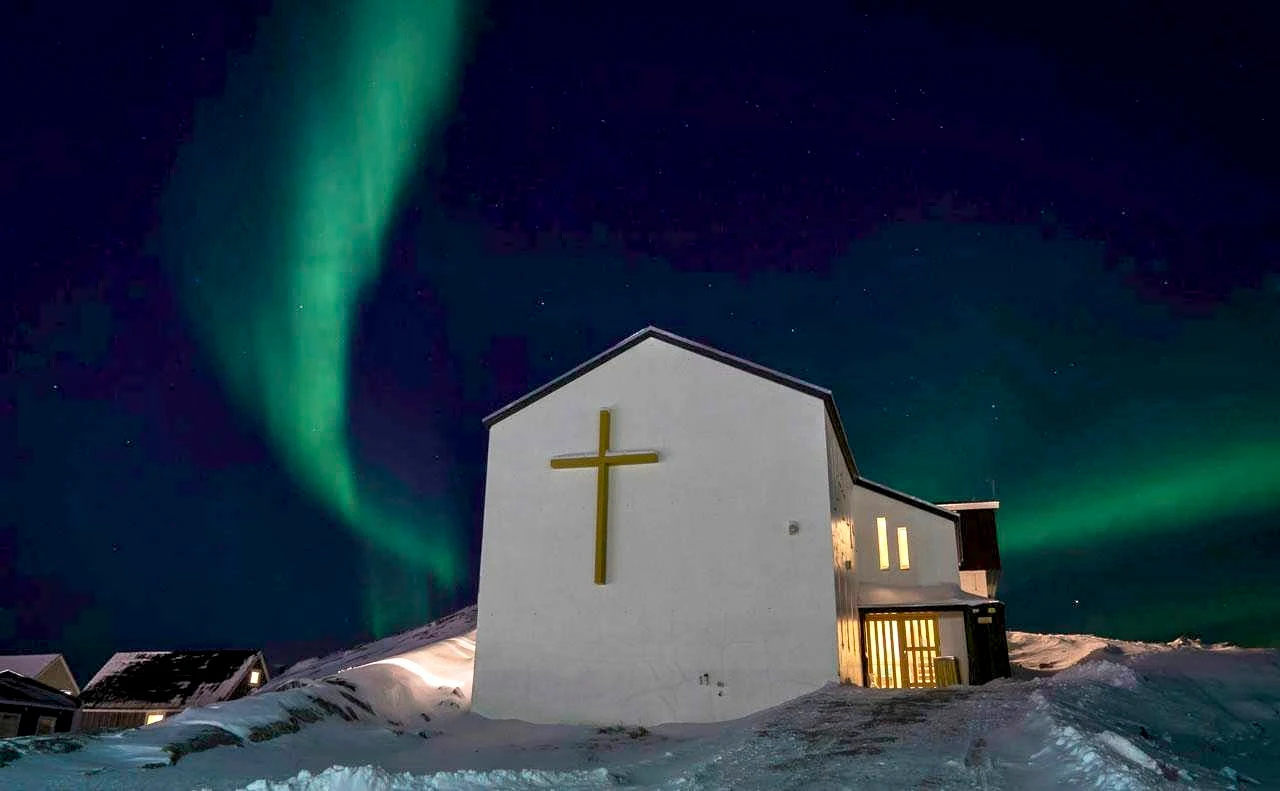
“People talk about it in shops, at work, and even after Mass,” said Father Tomaž Majcen, the island’s only Catholic parish priest, in an email to OSV News. “Most Greenlanders feel strongly about who they are and about their right to decide their own future.” The Slovenian-born Franciscan leads Christ the King Church alongside two fellow friars, forming the Conventual Franciscan Mission in Denmark’s Province of St. Jerome in Croatia.
Since 2023, the small team has cared for Greenland’s roughly 500 Catholics, part of a vast island community of about 56,000 people — predominantly Inuit — who live under a unique form of self-rule within the Kingdom of Denmark.
Washington’s Renewed Interest
White House Press Secretary Karoline Leavitt confirmed on Jan. 6 that President Trump remains intent on acquiring Greenland, which she described as a “national security priority.” The statement underscored that “utilizing the U.S. military is always an option at the Commander in Chief’s disposal.”
The message set off alarm bells across Europe. Only days earlier, Denmark, France, Italy, Poland, Spain, and the United Kingdom issued a joint declaration emphasizing that “security in the Arctic must be achieved collectively” and that “Greenland belongs to its people.” The statement asserted that only Denmark and Greenland hold legitimate authority over decisions regarding the island’s future.
Tensions were heightened by the U.S. unilateral military intervention in Venezuela on Jan. 3, which raised questions about Washington’s willingness to act without allied consensus.
A Complex Sovereignty
Greenland’s history within the Danish realm has long been shaped by the tension between self-rule and dependence. Granted home rule in 1979 and expanded autonomy under the 2009 Self-Government Act, Greenlanders possess the legal right to declare full independence. Yet, economic reliance on Danish subsidies remains a significant barrier.
According to Harvard University’s Belfer Center for Science and International Affairs, most Greenlanders support eventual independence. Still, limited economic self-sufficiency — and the strategic importance of the U.S.-run Pituffik Space Base, in operation for seven decades — complicates the path forward.
The Church’s Role Amid Uncertainty
For Father Majcen, the current moment is as much a spiritual test as a political one. “People are worried, but they are also very clear: this is our land, our culture, our home,” he said. “As a priest, I see how political uncertainty affects people’s hearts. It creates anxiety, especially about identity and the future of children and families.”
He described the Church’s mission as both pastoral and protective. “Our pastoral work today includes listening more, comforting more, and helping people name their fears. The Church must be a place of peace and hope. We must stand for human dignity, for the rights of the Inuit people, and for dialogue instead of threats.”
Amid the political turbulence, Father Majcen called for prayer and solidarity. “Above all, we pray — for wisdom for leaders, for peace between nations, and for the strength of our community. In tense times like these, the Church’s role as a home for everyone becomes even more important.”
His message extends beyond politics — toward a vision rooted in faith and human unity. “As people of faith, we are called to be peacemakers,” he said. “We should remember that we are all God’s children, and our true strength comes from compassion and working together for the common good.”
Inviting the faithful to prayer, he added, “Let us pray for peace and respect for sovereignty, and for our fragile Arctic environment — one of God’s most breathtaking but vulnerable masterpieces.”
- Raju Hasmukh with files from OSV News
Related Images:


