








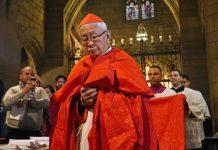
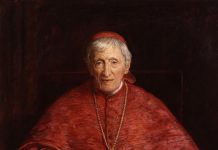

Cardinal Woelki of Cologne declares the German Synodal Way over for him, voicing deep doubts about a proposed permanent synodal conference.
Newsroom (27/01/2026 Gaudium Press ) When Cardinal Rainer Maria Woelki of Cologne announced that “for me, the Synodal Way is concluded,” his words closed a turbulent chapter in Germany’s recent ecclesial history. Speaking in an interview with Cologne’s Domradio, the cardinal made it clear he would not attend the sixth synodal assembly convening in Stuttgart this week — nor lend his support to proposals for a permanent “synodal conference.”
The remarks, carried by CNA Deutsch, underscore Woelki’s sharp skepticism toward the evolving German reform initiative that has repeatedly drawn warnings from the Vatican and Pope Francis himself.
A Personal End to a Controversial Journey
Cardinal Woelki explained that he had understood the Synodal Way to consist of five official assemblies, all of which he attended. When the bishops’ conference later called for an additional evaluation session, he declined.
“In my view, this body does not have the mandate to evaluate what an individual diocesan bishop or individual diocese has or has not implemented from the decisions of the Synodal Way,” he said. His absence from the sixth assembly effectively symbolizes a wider debate within Germany’s episcopate over the limits of reform and authority.
Waiting for Rome’s Word
The cardinal’s comments come as the Central Committee of German Catholics (ZdK) has already approved statutes for a new synodal conference. The proposal awaits decisions both from the German Bishops’ Conference — due at its February plenary session — and from the Vatican.
“We must wait to see what Rome actually says,” Woelki emphasized. “We must also wait to see whether the bishops’ conference at its plenary assembly in February actually approves the statutes in the form presented.”
The Cologne prelate rooted his reservations in his priestly promise: “I have to answer to my ordination vows. I promised to protect the faith of the Church and to walk the path in my diocese in unity with the pope.”
Tension Over Shared Governance
At the heart of the debate lies the planned structure of the new synodal conference — a body composed of bishops, ZdK representatives, and additional elected members with equal deliberative and decision-making authority. Woelki warned that such parity challenges the Church’s sacramental hierarchy.
“We live as Catholics in a hierarchically-sacramentally constituted Church,” he said. “This is not simply a question of organization but a question of the essence of the Church.”
He accepted that “listening well to one another” remains vital to synodality but drew a clear boundary: “The decision is made in the end by the one who has been given the office for this and who must above all know himself bound to the faith of the Church.”
Reforms and Real Disagreements
Woelki acknowledged progress made under the Synodal Way, particularly in addressing abuse prevention and reforming how power is exercised within Church structures. “I stand behind these themes,” he said, noting that the Archdiocese of Cologne had already implemented several local reforms.
Still, he lamented what he saw as a “great deficiency” — the Synodal Way’s neglect of evangelization, a point of repeated emphasis by Pope Francis since his 2019 Letter to the Pilgrim People of God in Germany.
Growing Voices of Doubt
Woelki’s decision coincides with leadership changes among the German bishops. Bishop Georg Bätzing of Limburg, a driving force behind the Synodal Way, announced on January 19 that he will not seek re-election as president of the Bishops’ Conference.
Meanwhile, Archbishop Georg Gänswein — former private secretary to Pope Benedict XVI and now apostolic nuncio to the Baltic states — delivered an even more pointed critique. Speaking to EWTN News on January 23, he said that “a series of demands of the Synodal Way lead away from the faith — they are not a clarification that leads to faith, but quite deliberately lead away from faith.”
“That cannot be the goal,” Gänswein continued. “I can only hope and pray that this wrong path simply comes to an end soon.”
Synodality and Its Meaning
For Woelki, the disagreement runs deeper than policy disputes — it is about the spiritual nature of synodality itself. “I perceive fundamentally different views of what synodality means,” he said.
“Pope Francis — as well as Pope Leo — repeatedly emphasize that synodality is a spiritual event, a tool for evangelization. I have the impression that at a certain point on the Synodal Way in Germany, it was primarily about implementing certain Church-political positions.”
With that, Cardinal Woelki appears to have closed his own participation in the process — not out of inertia, but conviction. In an era of unprecedented tension between Rome and reform-minded Catholics in Germany, his stance signals both the depth of division and the continuing struggle to define what the Church’s future synodality will mean.
- Raju Hasmukh with files from CNA
Related Images: