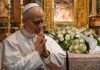


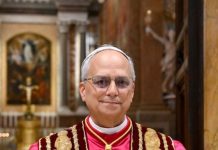



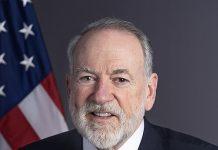





Turkish convert bishop Antuan Ilgıt, first Latin-rite Turk, welcomes Pope Leo XIV to Anatolia for Nicaea jubilee, embodying bridge between Islam and Christianity.
Newsroom (24/11/2025 Gaudium Press ) “We are heirs to the Nicene Creed, a legacy that we remind the whole world of from here,” declares Monsignor Antuan Ilgıt, Apostolic Administrator of the Vicariate of Anatolia. Speaking ahead of Pope Leo XIV’s first apostolic journey to Turkey (27-30 November), the 53-year-old Jesuit will host the Pontiff as he joins Orthodox Patriarch Bartholomew to mark the 1,700th anniversary of the First Ecumenical Council of Nicaea, the 325 gathering that produced the profession of faith still recited at every Mass.
In an exclusive interview, Turkey’s first Turkish-born bishop of the Latin rite – ordained in Istanbul’s St. Antuan Church on 25 November 2023 in the presence of Patriarch Bartholomew and Armenian and Syriac Orthodox leaders – shared the extraordinary journey that brought a former Muslim from the docks of Mersin to the episcopate.
Q: Monsignor Ilgıt, Pope Leo XIV arrives in Turkey this week for his first apostolic journey, joining Orthodox Patriarch Bartholomew to celebrate the 1,700th anniversary of the Council of Nicaea. What does this anniversary mean here in Anatolia? A: We are heirs to the Nicene Creed, a legacy that we remind the whole world of from here. This is the Holy Land of the Church—the land from which Christ’s message set out to reach all peoples. In 325, before the wound of division scarred the Christian community, bishops gathered and gave us the profession of faith we still recite at every Mass. To celebrate that here, with the Pope and the Ecumenical Patriarch, is an extraordinary grace.
Q: You yourself are a living sign of continuity and new beginnings: the first Turkish citizen to become a Latin-rite bishop in Turkey. How did that journey begin? A: I was born in 1972 in Germany to poor parents from Cilicia. We returned to Mersin when I was six because my father had become alcoholic. Life was hard—when there was no fish, we didn’t eat. Then, when I was still a boy, my mother was diagnosed with cancer at 35 and died soon after. I asked, “Why does God allow this suffering?” The Islam I grew up with didn’t give me answers. An imam said, “Everything comes from God; you must accept it.” That was not enough for me.
Q: So how did you find the answer? A: Years later, during an internship in Istanbul, I walked into St. Antuan Church. They were celebrating Mass in Turkish. I heard about a God who became man, who suffered with us and for us. For the first time, suffering had meaning. I began the catechumenate in Mersin, was baptised, did my military service, refused a career as an officer, and chose priesthood—even though it made me a disgrace in my family’s eyes.
Q: You studied in Italy and the United States, were ordained in 2010, and specialised in bioethics and interreligious dialogue. Why that path? A: My mother’s illness marked me deeply. I wanted to understand suffering from both Christian and Muslim perspectives, not starting from dogmas but from life’s questions that all religions share. I dreamed of being a bridge.
Q: That dream came true in an unexpected way. A: In 2018 I interpreted for President Erdoğan during his meeting with Pope Francis. I spoke personally with the Holy Father about my desire to serve the Church in Turkey—there were almost no local priests. He listened, and in 2021 he sent me home. Two years later, on 25 November 2023, I was consecrated bishop in Istanbul in the presence of Patriarch Bartholomew, the Armenian Patriarch, and Syriac metropolitans. It was a moment of profound ecumenical joy.
Q: Who are the Catholics the Pope will meet during this visit? A: Native Turkish Christians, now very few; refugees from Iraq, Syria, and Iran who have tripled our numbers; African students; and a growing number of Turkish Muslims becoming catechumens. This year we have had many. Baptism is not the finish line—it is the starting point. My own history helps me accompany them: I know what it is to be a newcomer, an immigrant, a convert.
Q: The 2023 earthquake devastated your cathedral and the region. How did that change your ministry? A: For weeks we lived, ate, and slept together among the ruins. Being with the people in everything—that is what it means to be a Turkish bishop. Civil authorities have been respectful; a deputy minister even attended my ordination. I have never felt in danger. Risk is part of the Jesuit vocation: we find God in all things.
Q: What is the mission of such a tiny Christian community in a 99% Muslim country? A: Our role is to be a seed. We possess a very beautiful heritage—the Nicene Creed was born on this very land. We must be authentic witnesses. Europe often sees Christianity as Eurocentric, but the center must be Christ, and His Gospel began spreading to the world from this land. Today the Church here has almost disappeared. We have to ask: what is the Spirit asking of us in history?
Q: And your answer? A: First, unity among Christians. Here we live a profound “ecumenism of life” with the Orthodox. Second, the young. They are not only the future but the present of the Church. Twice a year I gather youth from the entire Vicariate. They organise everything themselves and beg me for more opportunities. They want the Church to feel like home, and they want their voice heard in society. After the earthquake many are tempted to leave. We offer scholarships and, when possible, jobs, so they can experience the catholicity of the Church and still contribute to their country.
Q: As Pope Leo XIV prays at Nicaea alongside Patriarch Bartholomew, what is your personal prayer? A: That the Spirit who guided the bishops 1,700 years ago will guide us today: to unity, to courageous witness, and to the joy of proclaiming—right here, where it all began—that the God who became man still walks with His people, even when they are only a handful.
- Raju Hasmukh with files from Asianews.it
Related Images: