

















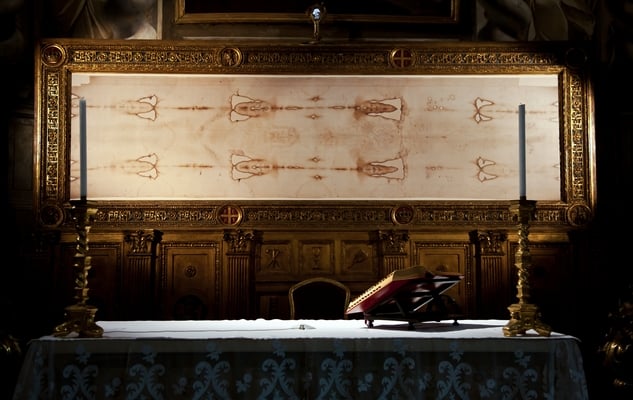
Dr. John Sottosanti, a veteran dental surgeon, has unearthed what he describes as compelling visual evidence of the lower front teeth on the face imprinted on the Shroud of Turin
Newsroom (03/10/2025, Gaudium Press )In a meticulously detailed academic paper that blends four decades of surgical precision with forensic scrutiny, Dr. John Sottosanti, a veteran dental surgeon, has unearthed what he describes as compelling visual evidence of the lower front teeth on the enigmatic face imprinted on the Shroud of Turin. This subtle yet striking feature—the incisal plane, or the aligned biting edges of the anterior teeth—appears to pierce through the fabric’s weave in a manner that defies conventional artistic replication, Sottosanti argues.
Published on Academia.edu Sottosanti’s study, titled “A Dental Surgeon’s Observance of Teeth in the Image on the Shroud of Turin,” draws on high-resolution photographs captured during the landmark 1978 Shroud of Turin Research Project (STURP). Magnifying these images and applying his expertise in oral anatomy, Sottosanti identifies a “distinct incisal plane” formed by the full crowns of the lower incisors, positioned just below the lower lip. Crucially, this plane runs perpendicular to the Shroud’s characteristic vertical striations—artifacts of its herringbone twill weave—distinguishing it from mere textile patterns that have long fueled accusations of pareidolia, or the brain’s tendency to impose familiar shapes on ambiguous data.
No analogous structure emerges for the upper teeth, which Sottosanti attributes to their concealment beneath the image’s depicted mustache and upper lip. “The lower teeth are not obscured by the presence of a distinct mustache, as are the upper teeth,” he writes, emphasizing the anatomical fidelity that aligns with a relaxed jaw in repose—a posture consistent with the Shroud’s portrayal of a crucified man. This precision, he contends, could only result from a radiant energy burst, akin to X-rays emanating from the body itself, searing the image onto the linen in an instant.
In a companion opinion piece for TheBlaze.com, Sottosanti expands on the ramifications: “If the lower teeth truly appear on the cloth, then the image could not have been painted or faked by human hands. It must have been created by radiant energy beyond the natural order—consistent with the very moment of the Resurrection.” He likens the phenomenon to an “energy similar to X-rays” that penetrated the cloth while preserving three-dimensional depth and anatomical accuracy, features that have eluded replication by even the most sophisticated medieval forgers.
The Shroud of Turin, a 14-foot-long linen relic housed in Turin’s Cathedral of St. John the Baptist, has tantalized investigators since its first documented exhibition in the 1350s. Revered by millions as Christ’s burial cloth—bearing faint front-and-back impressions of a crucified man, complete with wounds matching Gospel accounts—it has endured carbon-dating controversies (a 1988 test pegged it to the 13th-14th century, later challenged by contamination theories) and exhaustive scientific probes, including STURP’s ultraviolet and infrared examinations. Yet the mechanism of its image formation remains unsolved, with hypotheses ranging from vaporography to proton radiation. Sottosanti’s dental lens adds a novel forensic thread, bridging oral pathology and relic studies in a way that echoes prior speculations—such as those by STURP photographer Barrie Schwortz—but grounds them in rigorous, peer-reviewable analysis.
For the faithful, this revelation offers a poignant emblem of resurrection’s transformative power: teeth, symbols of earthly vitality, glimpsed through death’s veil. Scholars and skeptics, meanwhile, gain a fresh provocation to dissect the artifact’s refractory nature—one that has withstood pollen analysis linking it to Jerusalem flora, bloodstains typing as AB human, and dirt particles matching Calvary’s limestone. As Sottosanti notes in his paper, the finding “raises the issue that a form of energy…may have been emitted from the body, forming the image,” inviting empirical rebuttal or affirmation amid the relic’s 700-year saga of veneration and doubt.
Dr. John Sottosanti, a board-certified oral and maxillofacial surgeon, scientist, entrepreneur, and author, brings a personal odyssey to his inquiry. His 2023 Amazon bestseller, Mortal Adhesions: A Surgeon Battles the Seven Deadly Sins to Find Faith, Happiness, and Inner Peace, chronicles his evolution from agnosticism to devout Catholicism. The pivot began during the Shroud’s rare public exposition in Italy for the 2000 Jubilee Year, where its quiet profundity stirred dormant questions. It culminated in a visionary encounter in the tomb of a medieval saint along Spain’s Camino de Santiago pilgrimage route, propelling him toward “the fullness of faith.” Now, through his surgical scalpel and scholarly rigor, Sottosanti wields the Shroud not just as a historical puzzle, but as a mirror for existential reckoning.
As debates over the Shroud’s authenticity rage on—fueled by upcoming exhibitions and advancing imaging tech—Sottosanti’s work underscores its enduring allure: a linen whisper that challenges science, faith, and the boundary between them.
- Raju Hasmukh with files from Zenit News
Related Images: