

















Dame Sarah Mullally, the 63-year-old Bishop of London and former chief nurse, has been named the 106th Archbishop of Canterbury
Newsroom (03/10/2025, Gaudium Press ) In a landmark decision that shatters centuries of male-only precedent, Dame Sarah Mullally, the 63-year-old Bishop of London and former chief nurse, has been named the 106th Archbishop of Canterbury, becoming the first woman to lead the world’s 85 million Anglicans. The appointment, approved by King Charles III on the recommendation of Prime Minister Keir Starmer, caps Mullally’s improbable journey from hospital wards to the pinnacle of Anglican hierarchy, where she will assume office following the enthronement ceremony in early 2026.
Mullally, a self-described “theological liberal” who has championed women’s ordination and LGBTQ+ inclusion while upholding the Church of England’s traditional stance on marriage, steps into a role fraught with division. Her elevation, hailed by Cardinal Vincent Nichols as an opportunity for ecumenical “bonds of friendship” with Catholics, nonetheless risks deepening schisms within the Anglican Communion, particularly across the Global South. As the spiritual head of a church stretching from rural parishes in England to megachurches in Nigeria, Mullally inherits not just ceremonial robes but a tinderbox of theological tensions.
A Powder Keg in Africa: Conservative Backlash Threatens Communion Ties
Nowhere will Mullally’s appointment reverberate more sharply than in Africa, home to over half of the world’s Anglicans and a bastion of conservative orthodoxy. The continent’s Anglican provinces, led by firebrand archbishops in Uganda, Nigeria, and Kenya, have long chafed at the Church of England’s progressive drift on issues like same-sex blessings and female clergy—positions Mullally has vocally supported.
The response from GAFCON, the Global Anglican Future Conference—a coalition of 10 African provinces representing some 40 million members—has been swift and scathing. In a statement issued hours after the announcement, GAFCON’s primates declared the choice of Mullally an “abandonment” of traditional Anglicans, accusing the Church of England of prioritizing Western liberalism over biblical fidelity. “This appointment signals that Canterbury no longer speaks for the majority of the Communion,” the group stated, vowing to intensify efforts for an alternative global structure. GAFCON, formed in 2008 amid rows over sexuality, has already boycotted Lambeth Conferences and installed its own “primatial chairman,” Archbishop Henry Ndukuba of Nigeria, as a shadow leader.
Analysts warn that the fallout could accelerate Africa’s drift toward independence from Canterbury. Mullally’s liberal credentials will test the fragile unity of the Communion, especially in sub-Saharan Africa, where opposition to women’s ordination runs deep. In practical terms, this might mean frozen partnerships: diocesan exchanges halted, joint missions curtailed, and funding streams—from Western donors to African seminaries—diverted to GAFCON-aligned networks. For ordinary Anglicans in Lagos or Kampala, the ripple effects could manifest in pews emptying toward Pentecostal rivals, as conservative bishops leverage the news to rally flocks against “colonial” reforms from London.
Yet some African voices urge restraint. calling for “prayerful dialogue” while emphasizing Mullally’s nursing background as a bridge for shared social justice work on HIV/AIDS and poverty. Still, with GAFCON’s influence growing—its membership now outpacing the official Communion in the Global South—the appointment risks formalizing a two-tier Anglicanism: a progressive Canterbury core, and a conservative African periphery increasingly untethered.
The Slow Unraveling: Is This the Collapse of Anglicanism?
For critics, Mullally’s ascent is less a milestone, than a milestone in the Communion’s inexorable decline—a “collapse” long foretold by waves of defections and institutional fractures. The Church of England’s progressive lurch, from ordaining women priests in 1994 to bishops in 2015, has hemorrhaged traditionalists: an estimated 500 clergy crossed to Rome in the 1990s alone, with thousands more laity following. Mullally’s profile—her endorsement of same-sex blessings and critique of assisted suicide—exemplifies the fault lines that GAFCON labels a “betrayal of the gospel.”
This is no isolated spasm. Anglicanism’s vaunted “big tent” has shrunk under successive Cantors: Rowan Williams’s failed covenant to bind provinces, Justin Welby’s safeguarding scandals that eroded moral authority. Now, with a female primate whose views clash with the Communion’s conservative majority, observers like Anglican theologian Ian Paul decry a “terminal” schism. “Canterbury’s election of Mullally abandons the pretense of unity,” Paul wrote in a blog post, echoing GAFCON’s sorrowful communiqué. Membership figures underscore the peril: while Africa’s ranks swell, England’s pews have halved since 1980, prompting fears of a Communion cleaved along North-South lines.
Proponents counter that Anglicanism’s genius lies in its adaptability, not rigidity. Mullally herself, in her inaugural address at Canterbury Cathedral, pledged to “reconcile” the divided house, drawing on her nursing ethos of healing wounds. But with GAFCON poised to convene its next assembly in 2026—ominously timed post-enthronement—the specter of outright rupture looms, potentially consigning the 500-year-old tradition to a mosaic of rival fiefdoms.
Echoes of Newman: A Timely Catholic Beacon Amid Anglican Exodus
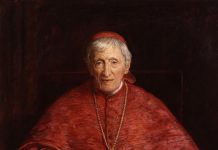
In the shadow of this Anglican earthquake, the Vatican’s impending elevation of St. John Henry Newman to Doctor of the Church on November 1—announced by Pope Leo XIV just weeks ago—strikes as providential timing. Newman, the 19th-century Oxford don whose 1845 swim across the Tiber catalyzed the Oxford Movement’s unraveling, embodies the very conversions Mullally’s tenure may unleash. His beatification in 2010 and canonization in 2019 already drew parallels to today’s Anglican exoduses; now, as Doctor—a rare honor for just 37 saints—Newman’s writings on conscience and ecclesial truth gain doctrinal weight at a moment when hundreds of clergy contemplate the Ordinariates established by Benedict XVI’s Anglicanorum coetibus in 2009.
The synchronicity is stark. Mullally’s liberal imprimatur could swell the ranks of those “former Anglicans” entering Catholic full communion, preserving liturgical patrimony under Ordinariate bishops like Steven Lopes in the U.S. “Newman’s defection wounded Anglicanism irreparably; his doctorhood now spotlights the path for the disillusioned,” notes Catholic Answers editor Jimmy Akin, linking the honor to a “Jubilee of Education” that underscores Newman’s intellectual apostolate. For Rome, it’s a soft-power masterstroke: welcoming Mullally’s Catholic counterpart in Nichols extends an olive branch, while Newman’s laurels quietly harvest the schism’s fruit.
As bells toll in Canterbury, the Anglican world braces for aftershocks. Mullally’s reign may heal some divides—or hasten the Communion’s reconfiguration into something unrecognizably plural. In an era of “profound global uncertainty,” as she put it, her voice promises compassion; whether it unifies or unravels remains the faith’s gravest wager.
- Raju Hasmukh with files from BBC, Catholic Herald, FT, GAFCON, The Guardian, Reuters, North American Anglican.
Related Images: