










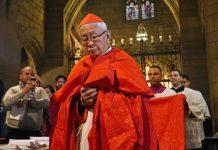

Papal Household Preacher Fr. Roberto Pasolini tells Pope Leo XIV and Roman Curia that true Christian communion embraces difference, not algorithmic uniformity.
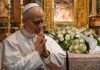
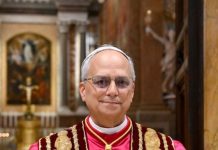
Newsroom (12/12/2025 Gaudium Press ) Fr. Roberto Pasolini, O.F.M. Cap., the Preacher of the Papal Household, delivered the second of his three Advent sermons to Pope Leo XIV and senior members of the Roman Curia on Friday morning. Under the overarching theme “Awaiting and hastening the coming of the day of God,” the Capuchin friar posed two piercing questions: What kind of unity must the Church bear witness to? And how can she offer the world a credible communion that is not reduced to generic fraternity?
Structuring his meditation around three biblical images – the Tower of Babel, Pentecost, and the repeated reconstruction of the Temple of Jerusalem – Fr. Pasolini issued a stark warning against the perennial temptation to confuse unity with uniformity.
The preacher began with Babel, describing it as humanity’s post-flood attempt to exorcise “the fear of being scattered” through a monumental project that concealed “a deadly logic.” The builders, he noted, rejected irregular stones in favor of identical bricks, pursuing a unity “not through the reconciliation of differences, but by means of uniformity.” The result, he said, is a unanimity that is only apparent and illusory, “achieved at the price of eliminating individual voices.”
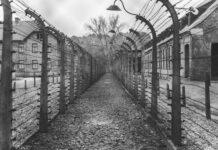
Turning to the tragedies of the twentieth century, Fr. Pasolini recalled how totalitarian regimes imposed “a single-minded ideology,” silencing and persecuting dissent. “Whenever unity is built by suppressing differences,” he declared, “the result is not communion but death.”
The same danger, he continued, persists today “in the age of social media and artificial intelligence.” Algorithms create “single-track information bubbles,” predictable patterns reduce human complexity to standards, and platforms reward instant consensus while penalizing “reflective dissent.”
The Church herself, the preacher acknowledged, has not always been immune. Throughout history, the unity of faith has at times has been mistaken for uniformity, sacrificing “the slow rhythm of communion, which does not fear dialogue and does not erase nuances.”
Against this homogenizing impulse, Fr. Pasolini set the act of creation itself. “God creates by separating, distinguishing, differentiating”: light from darkness, waters from dry land, day from night. “Difference,” he insisted, “is the very grammar of existence.” To reject it is to reverse the creative impulse in pursuit of a false security that is, in reality, “a refusal of freedom.”
Consequently, the confusion of languages at Babel is not divine punishment but divine remedy. By scattering tongues, God “restores dignity to particularity” and returns to humanity its “most precious gift”: “the possibility of not all being the same.” In a phrase that resonated through the chapel, Fr. Pasolini concluded this section: “There is no communion without difference.”
The sermon then moved to its luminous counter-image: Pentecost. There the apostles speak in their own languages and the crowd understands in theirs. “Diversity remains,” the preacher observed, “but it does not divide.” Differences are not erased to fabricate unity; they are transfigured “into the fabric of a broader communion” by the fire of the Holy Spirit.
Finally, Fr. Pasolini contemplated the Temple of Jerusalem, destroyed and rebuilt multiple times. Each reconstruction, marked by “enthusiasm and tears, new momentum and deep regrets,” offers a “precious compendium” for understanding the Church’s perennial need for renewal. Like St. Francis of Assisi stripping himself bare before the bishop, the Church is called to allow herself to be rebuilt again and again so that “the beauty of the Gospel” may continue to shine, faithful to her essence while ceaselessly placing herself at the service of the world.
As Advent deepens, Fr. Pasolini’s words left the Pope and the Curia with a challenging spiritual mandate: to hasten the day of God not by constructing new towers of uniformity, but by becoming living witnesses to a communion that embraces, reconciles, and ultimately sanctifies difference itself.
- Raju Hasmukh with files from Vatican News
Related Images: