











The Chinese Communist Party dreads Christianity not for destabilizing society, but for proclaiming God’s sovereignty over human rulers
Newsroom (30/10/2025, Gaudium Press ) In the pre-dawn darkness of October 9, 2025, Chinese police stormed homes across nine provinces, shattering the fragile sanctuary of prayer and fellowship that had sustained one of the nation’s most vibrant Christian communities. This was no isolated incident of harassment, but the opening salvo in what human-rights monitors describe as the most coordinated assault on Christianity since the Cultural Revolution’s brutal campaign to eradicate religion as “superstition” in the 1960s.
At the heart of the raids stood Beijing’s Zion House Church, a beacon of unregistered Protestant faith that had grown into China’s largest urban house church network. Founded by Rev. Mingri “Ezra” Jin, Zion embodied the Gospel’s call to build community beyond state control—a network of over 5,000 members spanning 40 cities and nearly 100 congregations, fortified by an online devotional ministry that once drew 10,000 daily participants before authorities erased its digital footprint.
Pastor Jin was seized from his home in Beihai, Guangxi Province. In the hours that followed, at least 22 pastors, preachers, and lay leaders were detained, among them Pastors Wang Cong, Yin Huibin, Liu Zhenbin, and Sun Cong. Thirteen women and nine men now languish in two Beihai detention centers; others endure house arrest or have vanished into the opaque web of “residential surveillance” sites. This systematic targeting of spiritual shepherds recalls the early Church’s trials under Roman emperors, where leaders were struck down to scatter the flock—yet faith, rooted in Christ’s promise, endured (cf. Acts 8:1-4).
For four decades since Mao Zedong’s death ended the Cultural Revolution’s reign of terror, China’s unregistered Protestant and Catholic communities navigated a tense tolerance: illegal in principle, but often overlooked. That delicate balance collapsed in October, exposing the Communist Party’s deepening intolerance for any allegiance that rivals its own.
Zion’s vitality—its appeal to urban professionals, scholars, artists, and intellectuals—made it a prime target. Unlike rural sects, this was a decentralized, educated movement thriving in China’s megacities, offering theological depth and charitable outreach free from the state-sanctioned Three-Self Patriotic Movement. Pastor Jin’s 2018 refusal to register, declaring that “Christ alone—not the party—is head of the Church,” echoed St. Peter’s defiance: “We must obey God rather than men” (Acts 5:29). Such fidelity to divine authority over Caesar’s demands provoked the regime’s fury.
Under President Xi Jinping, persecution has evolved from Maoist destruction to a calculated “sinicization” of religion—forcing churches to pledge loyalty to the Party first, rewrite Scriptures to align with socialist values, and hang Xi’s portrait beside the crucifix. This October offensive, centrally orchestrated by the Ministry of Public Security and United Front Work Department, deployed modern tools: AI-monitored sermons, infiltrated WeChat groups, frozen bank accounts, and overnight digital purges. It is totalitarianism refined by technology, yet fundamentally at odds with the Gospel’s truth that “no one can serve two masters” (Matthew 6:24).
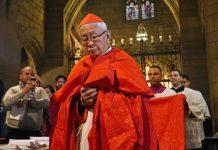
While Zion’s evangelical structure—agile, leader-driven, and internationally informed—invited decapitation strikes, Beijing’s approach to independent Catholics emphasizes co-optation. The 1950s schism birthed a dual system: the Party-loyal Chinese Patriotic Catholic Association and the underground Church faithful to Rome. The 2018 Vatican-China accord, under Pope Francis, granted the regime a voice in bishop appointments with papal veto—a compromise that has drawn underground faithful into the open, subjecting resisters like Bishop Joseph Zhang Weizhu of Hebei or Cardinal Joseph Zen of Hong Kong to isolation and arrest.
For Catholics, this raises profound questions of fidelity. The accord aimed to unify the Church, yet it risks subordinating sacramental authority to atheistic oversight, contravening Christ’s mandate that the gates of hell shall not prevail against His Church (Matthew 16:18). Evangelicals face erasure; Catholics, absorption. Both paths demand submission, violating the First Commandment’s exclusive worship of God.
This crackdown transcends China’s borders, testing the global conscience. As St. John Paul II warned in Centesimus Annus, totalitarian regimes fear faith because it affirms human dignity and transcendent truth—values the Party views as Western threats. Beijing’s pretext of “illegal religious dissemination” and “fraud” masks an ideological war against conscience itself, akin to the Uyghur interments in Xinjiang.
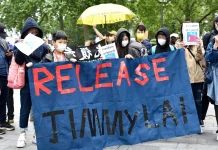
The timing—weeks before the Asia-Pacific Economic Cooperation Summit in Seoul—signals defiance. As President Donald J. Trump meets Xi on October 30, he carries a mandate rooted in America’s Judeo-Christian heritage. His first term recognized Xinjiang’s horrors as genocide and championed religious liberty worldwide. Now, he must demand the release of Pastor Jin, Pastor Wang Yi, Pastor Yang Rongli, lawyer Gao Zhisheng, and countless Catholic clergy, Tibetan monks, and Falun Gong adherents. Silence would betray the martyrs’ witness and America’s founding principle that rights come from God, not the state.
The Chinese Communist Party dreads Christianity not for destabilizing society, but for proclaiming God’s sovereignty over human rulers. Zion’s growth amid oppression proves faith’s resilience: “The light shines in the darkness, and the darkness has not overcome it” (John 1:5). Mao burned Bibles; believers transcribed them by hand. Pastors fell; new ones rose.
From his cell, Pastor Jin smuggled a two-word message: “FEAR NOT.” It echoes Christ’s assurance: “Do not fear those who kill the body but cannot kill the soul” (Matthew 10:28). History affirms that empires warring against God self-destruct. Xi’s campaign will fail; the Church in China—Protestant and Catholic—will prevail, seeded by martyrs’ blood.
American leaders, including President Trump and Vice President JD Vance, must amplify this truth, defending persecuted brethren as an extension of our nation’s values against communist oppression. In Seoul and beyond, let moral clarity prevail: Christ’s kingdom is not of this world, but it outlasts every tyrant.
- Raju Hasmukh with files from Tablet Magazine
Related Images: