



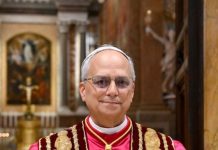












The Archdiocese of Cebu, led by Archbishop Alberto Sy Uy, has emerged as a beacon of hope, mobilizing aid and offering spiritual support to devastated communities.
Newsroom (01/10/2025, Gaudium Press ) A powerful 6.9-magnitude earthquake struck the central Philippines late Tuesday night, leaving a trail of destruction across northern Cebu. The disaster, centered off the coast of Cebu with a shallow hypocenter of 10 kilometers, has claimed at least 69 lives and injured 147, according to the latest reports from the Philippine Ministry of Health. As rescue and relief operations intensify, the Archdiocese of Cebu, led by Archbishop Alberto Sy Uy, has emerged as a beacon of hope, mobilizing aid and offering spiritual support to devastated communities.
Northern Cebu in Crisis
The quake, recorded at 9:59 p.m. local time by the Philippine Institute of Volcanology and Seismology, unleashed its strongest impact in northern Cebu, with intensity 6 shaking Cebu City, Leyte, San Fernando, and Northern Samar. Aftershocks, including one reaching magnitude 6, compounded the destruction, prompting authorities to issue an orange-level tsunami warning and urge coastal residents to avoid beaches. In Bogo, a city of 90,000, widespread building collapses have been reported, with approximately 30 fatalities. In San Remigio, the mayor declared a state of emergency, appealing for urgent food and water supplies to support thousands of displaced residents.
Hospitals in the region are overwhelmed, with officials considering patient transfers to other provinces. Cebu’s airport, however, remains operational, facilitating the flow of aid. President Ferdinand Marcos Jr. expressed condolences and pledged swift government intervention, but the scale of the crisis has stretched resources thin, raising fears that casualty figures may rise as assessments continue.
Archbishop Sy Uy’s Response
Archbishop Alberto Sy Uy has taken a hands-on role in the relief efforts, visiting hard-hit areas in northern Cebu, including the municipality of Daanbantayan. There, he assessed damage at key sites such as the district hospital and historic churches, including Santa Rosa de Lima, whose 150-year-old facade collapsed, and the parishes of San Michele in Tapilon and San Isidro Labrador in Maya. In a statement, the archbishop called for resilience and faith: “We continue to pray to our loving Father for calm and strength amid these trials. We entrust ourselves, our families, and our communities to His merciful hands. May the Lord shelter us under His wings, protect us from harm, and guide us to safety and peace.”
The Archdiocese of Cebu has also urged parishes to suspend Masses until structural safety checks are completed, prioritizing the safety of worshippers. On social media, the diocese emphasized the archbishop’s presence as a reminder that “the faithful are not alone in this trial,” assuring them of the Church’s prayers and support.
Voices from the Ground
Carmelle Estenzo, a young Filipina working with the Cebu Archdiocese, shared her personal ordeal with Vatican News. “I was evacuated last night because my building isn’t safe,” she said. “I’m still checking on my family and friends in the north, where the damage is severe. Please keep praying.” Estenzo noted that sacred sites, including a replica of the Capelinha de Fatima—a popular Marian pilgrimage destination modeled after Portugal’s Fatima shrine—have also been damaged.
Estenzo recently attended a Vatican communications course in Rome, where she met Pope Leo XIV. “When I told him I was from Cebu, his face lit up,” she recalled. “He even asked, ‘How is the Santo Niño?’” referring to the revered statue of the Child Jesus, a cherished symbol of Filipino faith. Pope Leo, who visited Cebu as Prior General of the Augustinians, holds a deep affection for the region. “I’m sure he is with us in heart and prayer,” Estenzo added.
Faith in the Face of Adversity
At the heart of Cebu’s resilience lies devotion to the Santo Niño de Cebu, the Philippines’ oldest religious icon. Gifted in 1521 by Ferdinand Magellan to the Queen of Cebu as a baptismal present, the Flemish-inspired statue of the Child Jesus is enshrined in the Basilica Minore del Santo Niño. Each January, it is carried in a grand procession, uniting Cebu’s faithful. In these dark hours, the Santo Niño remains a powerful symbol of hope, with prayers rising for strength and recovery as the region rebuilds.
As the Archdiocese of Cebu continues its relief efforts, the global Catholic community is called to join in prayer and support for those affected by this tragedy.
- Raju Hasmukh with files from Vatican News
Related Images: