















Those who seek to please God without reservation, at all times and in every situation, draw upon themselves the Divine gaze and care of the Sacred Heart of Jesus.
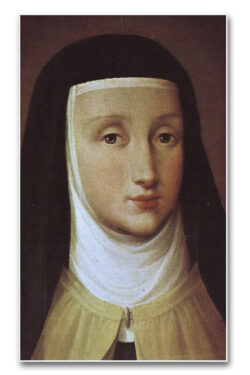
Newsdesk (12/01/2025 11:43, Gaudium Press) On July 15, 1747, the small and beautiful city of Arezzo was the setting for the birth of the second of Ignatius Redi and Camilla Balatti’s thirteen children. At the baptismal font she received the name Anna Maria.
The eminent Balatti family belonged to the nobility of the city of Siena, and Ignatius Redi held a distinguished position as grandmaster of the Military Order of St. Stephen – factors that combined to provide the girl with a peaceful childhood under favourable conditions, regulated by the acts of piety that tradition prescribed. From an early age, she received graces that prepared her well in advance for the mission that God had reserved for her.
Pious formation
The first instrument Providence used to give direction to Anna Maria’s spiritual path was her own father. A contemplative and pious man, he used to take his daughter on walks that ended up at the Capuchins’ church. Along the way he taught her how to pray the Salve Regina and the litanies, as well as how to look for the Creator in the beautiful Tuscan panorama: in the flowers, in the birds, in the sky… in everything! In this way, Ignatius Redi encouraged his little one to “spot” God in each of His creatures.
Also contributing to her Christian formation was the influence of her uncle Diego, a priest of the Society of Jesus. It was he who, years later, would introduce Anna Maria to the devotion she enthusiastically embraced and to which she devoted her life: the Sacred Heart of Jesus.
The custom of the time counselled the education of girls in convents, with one of the nuns as tutor. There they received the necessary formation to become good Christian ladies or, perhaps, if they showed signs of a vocation, to enter that same monastery. Thus, when Anna Maria was nine years old her parents sent her to the Benedictine Monastery of St. Apollonia in the city of Florence.
For seven years it pleased God to keep hidden in that cloister the little gemstone that He was polishing for Himself. It is astonishing that one of the few testimonies that remain about her from that time says: “She was a good and normal girl; nothing extraordinary was noted in her behaviour.”
God destined her, from her earliest youth, to pass unnoticed by human eyes in order to shine only for Him.
Devotion to the Sacred Heart of Jesus
With the outbreak of the Jansenist heresy, characterized by its rigid, formal and gloomy moralism, much of the society of the time had tasted of its poison and was consequently dominated by the almost exclusive consideration of God’s justice, to the exclusion of another of His perfections, goodness.
It was at this moment in Anna Maria’s life that Divine Providence rekindled in her soul the devotion to the Sacred Heart of Jesus that was timidly emerging in France. Even surrounded by an environment in which God was conceived as a relentless Judge, the tender love that sprang from the Divine Heart attracted her and strengthened her in a purpose made in childhood: to please God in everything.
This devotion was the portal through which the Most High wished to open His intimacy with Anna Maria, and the solid foundation that enabled her to remain steadfast in her faith amid the rigorist deviations of Jansenism.
Anna Maria shaped her spiritual life through the contemplation of the mystery of the Sacred Heart of Jesus, especially under the Eucharistic Species, and made the altar her delight. She would remain almost motionless for long hours in a mystical dialogue with Him who “so loved men.”
Curious call to a vocation
In September 1763, a former student of the school of St. Apollonia appeared at the doors of the establishment to say goodbye to her former teachers. Cecilia Albergotti, a companion of Anna Maria from one of the families of Arezzo’s high society, had decided to enter Carmel in order to seek her sanctification and better serve the Church.
The word “Carmel” resounded in Anna Maria’s soul with a timbre of mystery and irresistible attraction. Perhaps it suggested to her the feats of St. Elijah, the promise of the coming of the Blessed Virgin into the world, and the invitation to a close commerce with Heaven through radicality, sobriety and contemplation.
While she was talking with Cecilia, Anna Maria heard, mystically, with her interior senses, a distinct and clear voice that said: “I am Teresa of Jesus and I want you among my daughters!” Frightened, she ran to the altar to take refuge in the Sacred Heart of Jesus, but to her surprise the voice spoke again, this time leaving no room for doubt: “I am Teresa of Jesus and I want you among my daughters; soon you will be in my monastery.”
Vocation put to the test
The decision of the young Anna Maria to become a Carmelite surprised not only her teachers but also her family. Ignatius Redi, a prudent and devout man, wanted to try his daughter in the virtues that would be required of her by the strict Carmelite Order.
For this reason he obliged her to wait long months in which he tested her docility, solicitude, obedience and, finally, even her faith. The last of these tests was a real interrogation by three illustrious ecclesiastics who, examining her, concluded that the Carmel was the best place for her to love, serve and glorify God.
After this trying period, in which time and waiting conspired as merciless tormenters for Anna Maria, she finally said goodbye to her family and entered the “garden of God” in the city of Florence.
Another “Teresa” in the Carmel
For Anna Maria, entry into Carmel seemed like entering into Paradise on Earth. In her writings, she calls her companions in the habit “angels” and declares herself unworthy of being with them.
Her particular community was composed for the most part of elderly religious who saw in the young novice a hope for the continuity of that Carmel, but also the opportunity to satisfy petty selfishness.
The magnanimity of Anna Maria’s soul was not shaken by the mistreatment she received from some of her sisters in the vocation. On the contrary, she knew, with the help of grace, how to use these little crosses to offer to God a sacrifice of agreeable odour that increasingly conformed her to the Sacred Heart of Jesus, Victim of sinners.
After the novitiate period, the time arrived for her to make her profession among the daughters of St. Teresa. And at the moment of choosing her religious name, Anna Maria placed herself under the patronage of her founder, and of the great St. Margaret Mary Alacoque, her model in devotion to the Heart of Jesus.
Example of Obedience
What is known of the life of St. Teresa Margaret behind the cloistered walls is what could be expected of any fervent Carmelite: outstanding obedience, angelic purity and evangelical poverty. We may ask ourselves, then: what extraordinary things did she do to deserve the honour of the altars?
The answer is profoundly simple: her heroic fulfillment of the three vows, her exemplary obedience, her angelic purity, and her evangelical poverty.
For example, at one point, her obedience was put to the test when her superior entrusted her with the care of a sister who suffered from dementia.
Once an exemplary religious, the sick woman had become extremely hostile, brutish and rebellious. She had fits of madness in which she “demanded to eat precisely what the doctors forbade” or “indignantly rejected what she had wished for just moments before.”
When her will was not heeded she immediately unleashed all her fury against her benefactor. The young nurse was often insulted and humiliated by her.
There was another nun who had to share the duty of caring for the sick religious with the Saint. To make matters worse, this assistant had a false concept of charity and, in order to avoid mistreatment, she consented to satisfy all the sick woman’s whims.
Thus, the situation was delicate for Saint Teresa Margaret: if she cared for the patient’s health according to the rules she had received, she would attract a barrage of insults, as well as the incomprehension of the other nun, who blamed her for the patient’s fits of rage; if she consented to any of their wishes, she would be disobeying her superior.
In this impasse, she preferred to accept shame and affronts, thereby purchasing graces of fortitude and salvation for both the patient and her fellow sister nurse, rather than yielding in matters of obedience.
Three words that encompass the plenitude of love
The motto “to please God in everything” was for St. Teresa Margaret a beacon that guided her life outside and inside the monastery.
The vow that she had made at a very young age, perhaps with a somewhat undeveloped awareness of the profound significance of what she promised, became the key to open the Sacred Heart of Jesus and to penetrate into the most intimate relationship with Him. And the Divine Saviour wanted, in His turn, to show her how pleasing that mystical relationship was to Him by granting her an extraordinary grace.
One day, as the community sang the Office together, and “as the choir was praying Terce, upon pronouncing the words ‘Deus caritas est et qui manet in caritate in Deo manet et Deus in eo’ in the reading, Sr. Teresa Margaret felt herself enveloped by a wave of divine love” and was brought to experience the fullness of love enclosed in these three words: “Deus caritas est.”
What was shown to her in this ecstasy? God is love… the Holy Spirit is the Love of God. Did the Great Unknown manifest himself to her? With what graces had she been showered, and with what hopes had she been crowned?
Sadly, neither the heavenly communications that St. Teresa Margaret received at this moment, nor her impressions after the fact, have been recorded for history. It is only known that, after this, she was often seen during her daily tasks with her spirit recollected and absorbed in the repetition of the verse “Deus caritas est,” seeming to have her entire soul engaged in mystical communication with the Divine Redeemer.
This Carmelite Saint traveled an arduous path of perfection in her short life of 22 years. May we learn, with the help of St. Teresa Margaret, “to please God in all things,” so that we may be brought into His presence, His intimacy and His perpetual joy.
Text extracted, with adaptations, from Heralds of the Gospel Magazine no. 155, September 2020.
The post Carmelite St. Teresa Margaret Redi – Intimate Friend of the Sacred Heart of Jesus appeared first on Gaudium Press.
Compiled by Roberta MacEwan
Related Images: