




















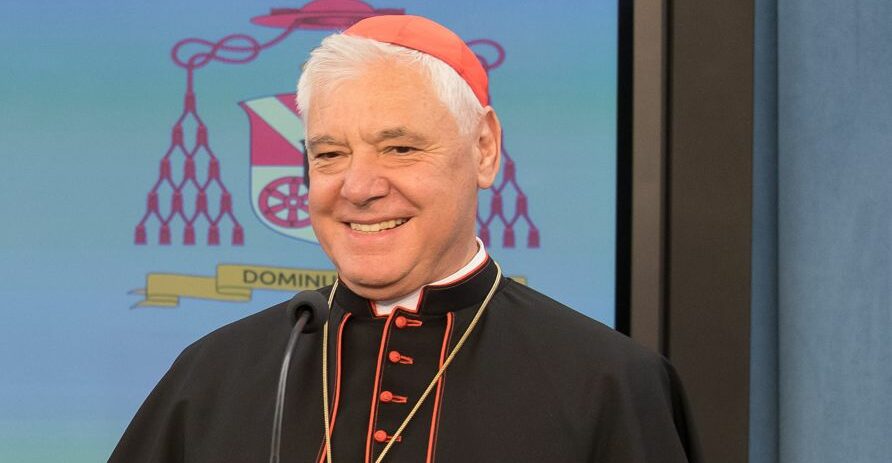
Cardinal Gerhard Ludwig Müller urges Catholics to reclaim spiritual depth amid secular noise, critiques Vatican II debates, and warns against the German Synodal Path’s ideological drift
Newsroom (16/12/2025 Gaudium Press ) In the hush of Advent, as the Church invites her faithful into a rhythm of anticipation and introspection, the words of Cardinal Gerhard Ludwig Müller resonate with a rare blend of theological depth and pastoral urgency. As the former prefect of the Dicastery for the Doctrine of the Faith, Müller has long stood as a guardian of Catholic orthodoxy, his voice cutting through the fog of contemporary confusion to recall believers to the unyielding truths of Revelation. This season, traditionally a time of candlelit vigils and prophetic promises, takes on renewed significance in Müller’s reflections. Far from a mere prelude to holiday festivities, Advent emerges as a vital “school of watchfulness, purification, and hope,” a liturgical journey that demands a reorientation of the soul toward Christ’s incarnate mystery.
At the heart of Müller’s message is a profound understanding of Advent’s place within the liturgical year, which he describes as a mirror of salvation history itself. The Eucharist, he notes, makes God’s redemptive work sacramentally present, allowing the faithful to encounter the prophets’ voices anew. Isaiah’s prophecies loom large in this narrative: “The people who walked in darkness have seen a great light… For unto us a child is born, unto us a son is given; and the government shall be upon his shoulder” (Is 9:1, 5). These words herald the Messiah, the Savior who establishes God’s indestructible Kingdom through His Cross and Resurrection. Müller emphasizes that in Jesus, all prophetic promises are fulfilled “beyond measure.” As the Son of God who assumed humanity through Mary, Christ redeems humanity from sin and death, elevating believers to the status of God’s adopted children. Echoing St. Paul, he reminds us: “When the fullness of time had come, God sent his Son, born of a woman, born under the law, to redeem those under the law, so that we might receive adoption as sons” (Gal 4:4–5). This adoption liberates us from slavery to worldly powers, anchoring our faith in a victory that transcends temporal struggles.
Yet, in an age where Advent is often eclipsed by the clamor of consumerism, Müller calls for a deliberate recovery of this spiritual work. He warns against reducing Christmas preparations to superficial rituals—purchasing gifts or basking in “seasonal romanticism.” Such distractions, he argues, obscure the deeper reality: the need to open our ears and hearts to Jesus’ entry into our lives. True hope, Müller insists, cannot be placed in “false prophets and pseudo-messiahs of ideological and political manufacture,” whose twentieth-century legacies include world wars and genocides that inflicted “unspeakable misery” on humanity. Instead, our ultimate reliance must be on God, who grants “the victory through our Lord Jesus Christ” (1 Cor 15:57). This perspective invites Catholics to reflect on life’s meaning and their own identity, recognizing that existence is not accidental but divinely ordained.
To foster this renewal, Müller proposes practical disciplines that harmonize interior and exterior dimensions of human nature—a unity of body and soul, reason and will. Embedded in ecclesial, civil, and cultural communities, individuals can daily affirm their eternal election in Christ: “From eternity he has been chosen in the Son of God—destined, even before the creation of the world and in anticipation of his historical existence, to become a son or daughter of God through Jesus Christ” (Eph 1:4–5). This awareness counters materialistic entanglements, freeing believers from the “machinery of entertainment and material care,” the “numbing noise of the market and the media,” and the “diabolical illusion of worldly doctrines of salvation” with their deceptive propaganda and idolatrous leaders.
Müller extends this critique to broader anthropological misconceptions, rejecting the confusion of Darwinism as a biological theory with metaphysical claims. Humanity, formed from animal precursors according to God’s logos and will, is not ontologically a “naked ape” destined for self-evolution into a “superhuman creature” or a “highly technological cyborg.” Rather, our rational capacity for self-determination calls for intellectual and spiritual formation through meditation, prayer, and liturgy. These practices cultivate a renewed heart, enabling the faithful to receive Christ amidst cultural noise.
Shifting to Europe’s spiritual landscape, Müller unpacks the apparent paradox of accelerating secularism juxtaposed with immigration from robustly religious cultures. He contends that European secularism is not neutral but a form of “de-Christianisation”—sometimes soft, sometimes violent—aimed at replacing divine salvation and truth with “self-redemption.” Since the eighteenth century, deism and notions of “natural religion” have positioned Islam as an ally against Christianity, a dynamic that persists in contemporary anti-“Islamophobia” efforts. These, Müller suggests, anticipate Islam’s eventual secularization and accommodation of “atheistic woke anthropology,” contrary to its own tenets. For Christians, however, the key lies not in societal religiosity but in personal fidelity: placing trust in God through faith, hope, and charity, for “in Jesus Christ he is our only hope.” This stance equips believers to navigate cultural shifts without compromising their core convictions.
The discussion inevitably turns to Vatican II, where debates over its “spirit” versus “letter” continue to divide the faithful. Müller sharply rebukes this distinction as an “insult to the theological intelligence of every Catholic.” Assent to the Church’s teaching—that Jesus is Lord—comes only through the Holy Spirit (1 Cor 12:3). The Council’s doctrine perpetuates the apostles’ teaching, keeping Revelation’s full truth alive in history. Invoking a “spirit of the Second Vatican Council” against its texts risks conflating it with the “spirit of the world,” as in Hegelian philosophy or Romantic nationalism—utterly distinct from the Holy Spirit, the third Person of the Trinity, who inspired Scripture and safeguards the magisterium from error. Thus, the authentic reception of Vatican II today demands embracing its continuity with Tradition, allowing the Spirit to guide the Church’s ongoing witness.
Addressing the SSPX’s persistent challenges, Müller acknowledges fruitful dialogues but laments their circular nature. Resolution requires acknowledging Vatican II as the twenty-first ecumenical council, interpreted through Catholic hermeneutics as outlined by Irenaeus of Lyon. He dismisses “foolish talk” of sede vacante, calls for council revision, or assertions of the Lefebvrists as Catholicism’s sole guardians. While conceding their valid identification of wounds from modernist “self-appointed reformers,” Müller insists schism is never justified. The Church, as St. Augustine taught against the Donatists, comprises saints and sinners alike. Quoting Augustine’s words to Petilianus—”It was not we who separated ourselves from you—you separated yourselves from us. You withdrew from communion with the universal Church” (Contra litteras Petiliani II, 38)—Müller underscores the imperative of unity. The present moment is a “kairos” for reconciliation in Christ’s truth, grounded in St. Peter and his successor, Pope Leo XIV, as the “enduring principle and foundation of unity in faith and sacramental communion” (Lumen Gentium 18).
Müller’s most pointed critique targets the German Synodal Path, a development sparking worldwide unease. He affirms that German dioceses are Catholic only through participation in the universal Church’s faith, sacraments, and divine constitution. The Synodal Path’s organization lacks magisterial authority and cannot function as a “constituent assembly” to forge a “German national church” akin to Anglican or Protestant models. Even the Pope and bishops are bound to Revelation, Scripture, and Apostolic Tradition, prohibiting doctrines contrary thereto—a constraint doubly applicable here. Müller labels the Path’s integration of gender ideology a “heretical attempt” to supplant Christian anthropology, peddled to the naive as doctrinal “development.”
He observes the Path’s minimal engagement with core elements—God, Christ, the Holy Spirit, sacraments, grace, eternal life—relegated to “ornamental” status, masking the Church’s mutation into a “religious-social NGO with spiritual slogans.” This assessment aligns with critiques from “competent German bishops and eminent theologians.” The progressive trajectory in Germany since the 1970s has yielded a “devastating record”: widespread departures, vacant seminaries, shuttered monasteries, and pervasive ignorance of the faith—reminiscent of St. Boniface’s evangelization efforts 1,300 years ago (Ep. 28).
Invoking Pope Francis’s 2019 letter “To the Pilgrim People of God in Germany,” Müller highlights the Pontiff’s emphasis on New Evangelization over structural reform: “For the Church is not something we make, nor can it be reinvented by us.” Francis’s admonition—that renewal comes not from “adapting to the spirit of the times, but by rediscovering the Gospel”—extends beyond Germany to all Catholics in this historical juncture.
Through Müller’s lens, Advent’s invitation to purification becomes a microcosm of the Church’s broader vocation: to stand firm in Tradition amid trials, fostering hope in Christ’s victory. His reflections challenge believers to transcend superficiality, embrace doctrinal integrity, and pursue unity. In a world of paradoxes and polarizations, this vision offers not mere critique but a luminous path back to the faith’s foundational mysteries, where the light of the Incarnation dispels all darkness.
- Raju Hasmukh with files from Catholic Herald
Related Images: