








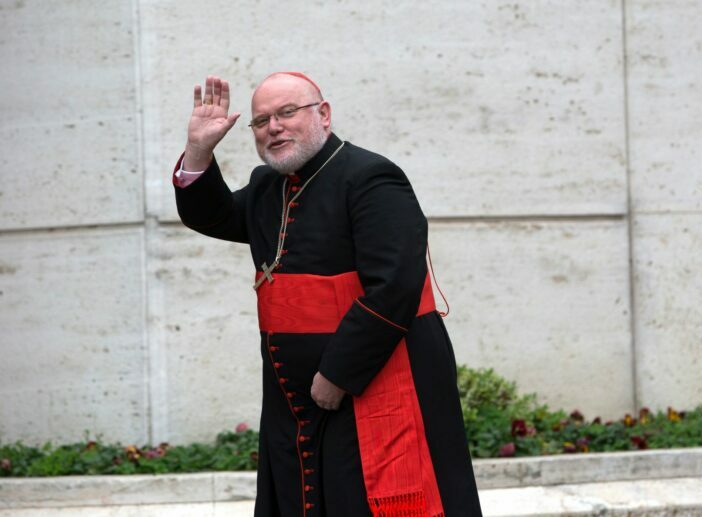
Cardinal Reinhard Marx urges clarity from Pope Leo XIV on freedom of expression, warning of democracy’s fragility and the need for a vocal Church
Newsroom (13/01/2026 Gaudium Press ) When Pope Leo XIV addressed diplomats in his first New Year’s speech, his reflections on the state of freedom in the Western world drew global attention—and a notably cautious response from within the Catholic Church itself.
Cardinal Reinhard Marx of Munich, one of Germany’s most influential churchmen, responded on Monday in Bonn with skepticism and reserve. Speaking at an event hosted by the Catholic media company PubliKath, Marx said he found the Pope’s words difficult to interpret. “I’m uncertain about this quote because I can’t make sense of it,” he explained, suggesting the papal critique could apply to American politics or any number of contemporary societies. “It would have been better if the Pope had given more concrete examples.”
Pope Leo had lamented what he described as the narrowing of expressive freedom in Western democracies. “It is regrettable,” he said, “that the space for genuine freedom of expression is being restricted while a new language with an Orwellian flavor develops—one that seeks inclusivity but ends up excluding those who do not conform to its ideologies.” Marx’s reply was half reflective, half dismissive: “I would have spoken more forcefully,” he said with a wry edge. “But thankfully, I’m not the Pope.”
Democracy “in Troubled Waters”
Behind Marx’s cautious tone lay a deeper unease about the health of democracy itself. “Democracy is in troubled waters,” he said, noting how easily societies can slip into authoritarian patterns if freedoms are taken for granted. “A look at the beginnings of the Nazi regime shows how quickly things can change.” The lesson, for Marx, was clear: vigilance and the defense of human dignity are essential.
This, he argued, gives the Church an indispensable role. “The Church must speak out,” he urged. Once content to observe from the sidelines, the Church now finds itself defending the very ideals of modernity—freedom, enlightenment, open debate—that it once approached ambivalently. “A Church that withdraws or views the world as a misfortune—that’s not what we want,” he said. “We want a free, open society.”
The State’s Duty to Protect Speech
Also present at the PubliKath celebration was Hendrik Wüst, the Minister-President of North Rhine-Westphalia, who echoed Marx’s urgency from a political standpoint. “Freedom of the press is not a gift from the state,” Wüst argued. “It is a fundamental right that the state must defend.” Without independent journalism, he said, democracy and freedom would wither.
But Wüst also drew a distinction between liberty and license: “Freedom of expression isn’t unlimited; it only exists with responsibility.” He cited Europe’s prohibition of Nazi symbols as a justified limit born of history. “Hundreds of thousands of Americans died trying to overthrow National Socialism. That’s why freedom of expression isn’t absolute.”
His remarks also extended into the digital realm. Wüst criticized major U.S. tech platforms for avoiding regulation under the guise of preventing censorship. “The EU will only remain credible if its rules are consistently applied,” he said, calling for consistent oversight in areas from media to artificial intelligence. “AI is both a challenge and an opportunity,” he added, capable of promoting critical thought but never replacing genuine human inquiry.
Journalism as the Church’s New Pulpit
For both Marx and Wüst, the evening’s subtext was PubliKath’s own mission. Emerging from a restructuring of the Catholic Media House, PubliKath GmbH encompasses outlets such as the Catholic News Agency (KNA), katholisch.de, and filmdienst.de, forming a new hub for responsible Catholic journalism in Germany.
“PubliKath stands for responsible journalism that encourages dialogue and takes a critical and constructive view of our world,” Wüst said. In an age of algorithmic news and AI-generated content, he concluded, humanity—in both senses of the word—must remain journalism’s core value. “Independent journalism is indispensable for our democracy and for trust in the fundamental principles of the state.”
For Marx, that is precisely where the Church can matter most: in the intersection of faith, freedom, and public discourse. Where the digital tide can drown nuance and civility, the Church’s voice, he implied, must remain steady—firm enough to defend democracy, humble enough to learn from it.
- Raju Hasmukh with files from katholisch.de
Related Images: