












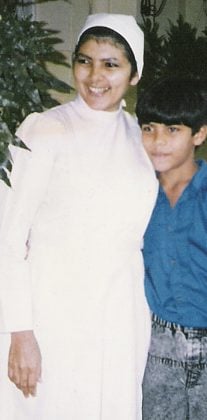
Strong and confident, she knew no fear or weakness, never abandoning her ‘battlefield.’ ‘I would rather spill my blood than leave here.’
Newsdesk (27/01/2025 11:05, Gaudium Press) Born on October 20th, 1953, into a rural family in the municipality of Açu, Rio Grande do Norte, Brazil, she was baptized three months after her birth.
Her father, João Justo da Fé, a small landowner, cultivated his farm to support a large family of 16 children. He was a pious man of strong character. He admired the stories of the Patriarchs of the Old Testament and imitated them in some ways. Maria Lúcia, her mother, was aware of the commitment she had made when she got married: the upbringing of her children. This Catholic family reflected the love between parents and children, but there was also discipline and severity when it was necessary to correct the little misbehaviours and mischief of childhood.
From childhood, Lindalva showed a propensity to help others and was sensitive to the suffering of others. She did not like fights and never got angry. She liked to run, swim in the nearby pond, or climb trees to eat freshly picked fruit. But her favourite pastime was modelling clay dolls, which she left to dry in the sun, and then sewing clothes for them from scraps of fabric.
Revealing herself to be very mature for her young age, she was conscious of her parents’ sacrifices to support and educate their large family, and wanted to help them in some way. Thus, she was always available to help her mother, learning to cook and sew at an early age. She sought to imitate the example of her mother who, despite being poor, took from her meagre pantry to help others in greater need.
She lived in the world without being of the world
The children grew up, needed to study, and the demands increased. João decided to move to Açu, where several of them found employment. Lindalva attended primary school and worked as a nanny in the home of a wealthy family. When someone she knew needed help, due to illness or any other reason, they turned to her. ‘You must have a vocation for nursing, because you are always available and do everything with joy!’ one of her companions would say to her.
When the first daughter of her older brother, who had married and lived in Natal, was born, she went to live with him in that capital city, where she helped the young mother and continued her studies. She got a job as an office assistant and led a life like any other young woman of good principles. She lived in the world, but did not belong to it. She had no plans to marry and volunteered at a home for the elderly run by the Daughters of Charity.
Shy and reserved by nature, she was transformed there, becoming expressive, full of life and with a contagious joy. The elderly eagerly awaited her, due to her patience, affection and kindness. It was a vocation that matured strongly in her soul. “The fruit of the Spirit is love, joy, peace, patience, kindness, generosity, faithfulness.”(Gal 5:22), says the Apostle. This was precisely what Lindalva manifested throughout her relatively short life.
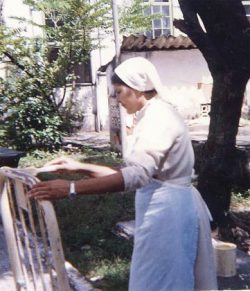
Joy in giving to others
She began studying nursing so that she could give more of herself and then made the big decision of her life: in September 1987, she wrote to the Provincial of the Daughters of Charity, asking to be admitted as a postulant. “I have long felt the desire to enter religious life, but only now am I available to follow God’s call. I am ready to devote myself to the service of the poor,” she wrote.
Admitted two months later, she was sent to do her postulancy at the Santa Teresa School community in Olinda, Pernambuco. This period was nothing more than a continuous exercise of the purpose she had made, to base her spiritual life on happiness in Christ and the good of her neighbour. The testimony of her superiors during this phase was always one of admiration for her availability, humility, and joy in giving to others, whether to the poor or the elderly, or to the other sisters in community life.
“I want to be a saint!”
She progressed in her interior life, surrendering herself more and more into the hands of the One to whom she had abandoned herself, entrusting her destiny entirely to Him, as the Prophet King recommends: “Commit your way to the Lord, trust in Him, and He will act” (Ps 36:5).
Some of her letters confirm the fullness of this surrender to the Lord and reveal the authenticity of the vocation she had chosen. ‘I am very happy. (…) My destiny is in God’s hands, but I desire with all my heart to always serve with humility, in the love of Christ,’ she wrote to a friend in March 1988.
Dom Chautard teaches that the soul of every apostolate is the overflowing of the interior life. And Lindalva’s gift of service was based on her life of piety and prayer. She did not limit herself to alleviating the physical sufferings or sorrows of the most needy, but sought to nourish their spirits with prayers and good advice. She liked to pray with them, especially the Rosary meditations, accompanied by songs to Our Lady.
Her favourite prayer was the Rosary. She always carried her Rosary with her and took advantage of any free time to recite it. She explained this habit by saying, ‘There are many people who need my help, and I can do nothing but pray for them.’
Her desire to progress in her spiritual life led her to ask her superior, Sister Maria Expedita Alves, candidly how to become a saint. With wisdom, she replied:
“My daughter, no one is born a saint; this can be achieved by seeking perfection in everyday life, and also in every action, even the most insignificant.
‘I want to be a saint!’ replied Lindalva, staring at the Mother Superior with a deep gaze.
Here, everything is grace!
This firm desire marked her life, in the simple and ordinary journey of a postulant, towards the fullness of religious life, in the practice of the evangelical counsels of chastity, poverty, and obedience.
Under the watchful eye of her superiors, she was admitted to the novitiate, taking a more decisive step in her commitment to Jesus, within the charism of her Congregation: service to the poor and needy. On the Feast of Our Lady of Mount Carmel, July 16th, 1989, she took the habit of the Daughters of Charity and became Sister Lindalva.
In a letter to a friend that same year, she expressed how fulfilled she felt in religious life: “Here, everything is grace! We live in profound silence and union with God. (…) My thoughts and my desire to love God above all things make me feel very happy. Another part of our life is the love we have for the people we meet, but it is through our love for God that we love other creatures; we must not let this love be greater than our love for God.”
Everyone admired her greatly.
At the end of her novitiate, on January 26th, 1991, Sister Lindalva was sent to a hospice for the elderly in Salvador, the capital of Bahia. In a letter to a fellow sister, she renewed her resolve to remain humble and simple in the face of the difficulties that would surely come, recalling the words of Scripture: “Do not fear, for I have redeemed you; I have called you by name, you are mine.When you pass through the waters, I will be with you; and through the rivers, they shall not overwhelm you.” (Is 43:1-2).
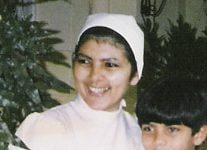
It was with this confidence that she crossed the gates of the old 19th-century mansion, where the Abrigo Dom Pedro II operated by the municipal public administration but under the care of the Daughters of Charity. She was given the task of caring for the São Francisco pavilion, with 40 elderly people, located on the first floor of the imposing building. In a short time, she captured the hearts of her superior and her fellow nuns, as well as the elderly, with her cheerful manner and the perfume of holiness that surrounded her.
Everyone admired her greatly.
She calmed those who complained, reminding them of the sufferings of the Saviour, and gave some occupation to those who could still do something, so that they would feel useful. Wherever there was a need, Sister Lindalva was there, with her always cheerful and charitable manner.
She took care not only of the material needs of the elderly, but also of their spiritual life. She prayed the Rosary with them and brought the Chaplain to administer the Sacraments to them. Her vigilance in matters of chastity was evident even when she went to fetch the priest, as she always asked someone to accompany her. She was assiduous in the activities of the community, and when she had a few minutes to spare, she was invariably in the chapel, praying a little more.
In the little time she had left after her work at the home, Sister Lindalva participated in the Saint Louise de Marillac Volunteers of Charity Movement, which visited the elderly and sick in the outskirts of the city. This movement was divided into groups, and she belonged to the Saint Maria Goretti Group. Perhaps this was not by mere chance, as will be seen below.
Ascent to Mount Calvary
That holy nun could not have imagined that her beloved hospice would be her Mount Calvary, the place chosen by Christ for her to mix her blood with His. The problems began in January 1993, when Augusto da Silva Peixoto was admitted there. At only 46 years of age, he was not old enough to be in a charitable establishment for the elderly, but the nuns had to accept him for political reasons. They housed him in the pavilion under the care of Sister Lindalva.
Devoid of religious and moral principles, Augusto took an interest in the nun, who led a blameless life, with evil intentions and began to harass her insistently and inappropriately. The warnings given to him by other residents and the director of the home’s social sector only served to increase his strong feelings of frustration at always being rejected.
Sister Lindalva, who would rather die than break her vow of chastity, found herself forced to be very careful, avoiding any behaviour that could be misinterpreted by that unscrupulous individual. She recounted the situation to some nuns and fellow volunteers and intensified her prayers. But out of love for the elderly and fidelity to the obedience that had assigned her to the home, she did not want to leave. Strong and confident, she knew no fear or weakness, never abandoning her ‘battlefield.’ ‘I would rather spill my blood than leave here,’ she said during a community break.
“She never gave in”
On Monday of Holy Week, this nefarious man bought a fisherman’s knife at the market, with the deliberate intention of killing the nun who stood as an insurmountable barrier to his evil intentions.
Throughout the week, Sister Lindalva had participated, at dawn, in the Way of the Cross at the parish of Boa Viagem. As she walked through the nearby streets in the early hours of Good Friday, April 9th, 1993, meditating on Jesus’ Way of Sorrows, she certainly had no idea that her own personal ascent to Calvary would also culminate that day.
Returning to the hospice, she went straight to the dining room to fulfil her task of serving breakfast to the elderly, without noticing the presence of Augusto sitting on one of the benches in the garden. He, who was waiting for her, climbed up behind her, entered through the back door of the hall and attacked her from behind with the knife, in an insane and diabolical rage. The victim barely had time to stammer, ‘God protect me!’ She received a total of 44 stab wounds.
While cleaning the weapon stained with innocent blood on his own clothes, the crazed criminal roared: ‘She never gave in! Here is the reward…’ He thus testified that Sister Lindalva had given her life as proof of her love for God, by keeping her purity intact, in a true martyrdom to which the residents themselves had borne witness.
Seed of new vocations
Throughout the night, a continuous stream of faithful passed through the hospice, eager to pay their last respects to the nun. The Primate Archbishop of Brazil at the time, Cardinal Lucas Moreira Neves, officiated the funeral ceremony and stated in his homily that “the blood of the victim will be the seed of new vocations, not only for the Daughters of Charity, but also for all the Congregations of the Church of God.”
The Church proclaimed her Blessed on December 2nd, 2007, during a ceremony held at the Manoel Barradas Stadium in Salvador. Her remains are currently in the chapel of the Abrigo Dom Pedro II. Blessed Sister Lindalva is an example of how joy and purity are characteristic features of the holiness to which we are all called.
This is what Cardinal Saraiva Martins said at the beatification ceremony: “I wish everyone, and I invoke from the Lord for each one of you, that joyful vitality that she knew how to transmit to others, which is perhaps Lindalva’s most captivating legacy, to know how to infect those around us with the ineffable joy that has its roots in the feet of the Risen Christ, aware that as children of God, we are all called to be saints and that holiness is a path of freedom for each one of us.”
By Sr. Juliane Campos, EP.
Text taken from Heralds of the Gospel Magazine, April 2010.
Compiled by Roberta MacEwan
The post Blessed Lindalva: A Life of Joy Crowned by Martyrdom appeared first on Gaudium Press.
Related Images: