





















Vatican expert Austen Ivereigh attacks Pope Leo XIV for reviving the lamb blessing, calling it contrary to Laudato Si’ and animal welfare.
Newsroom (22/01/2026 Gaudium Press ) In a curious twist at the Vatican, papal biographer and longtime Vatican observer Austen Ivereigh has ignited controversy by accusing Pope Leo XIV of “failing to comply” with the ecological spirit of Laudato Si’, Pope Francis’s 2015 encyclical on care for creation. The remarks came in response to what most observers would consider one of the gentlest and most symbolically rich of Vatican rites: the blessing of lambs on the feast of Saint Agnes.
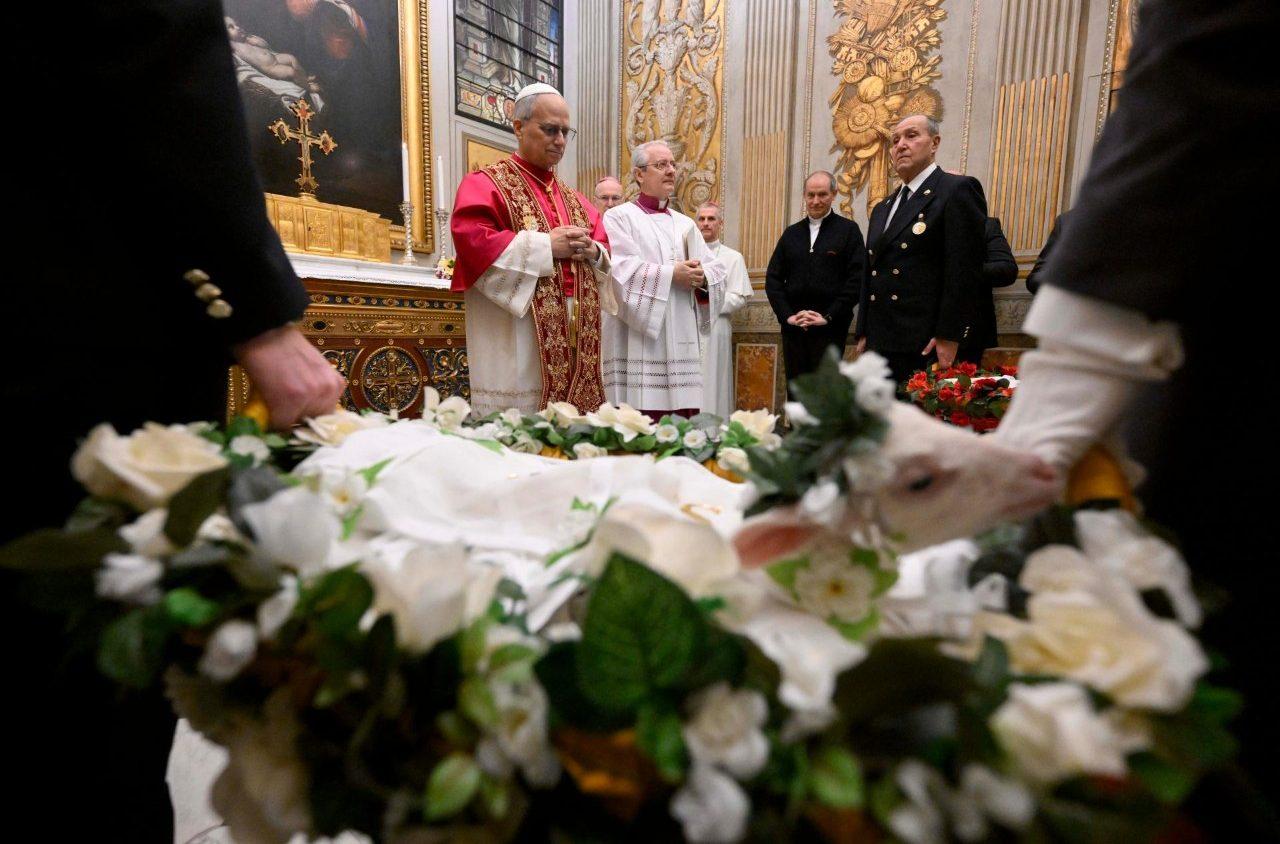
The tradition, revived by Leo XIV after a hiatus under his predecessor, ties the innocence of lambs to the purity of Saint Agnes, whose name itself means “little lamb” in Latin. The wool from the blessed animals is later used to weave palliums—white woolen bands worn by metropolitan archbishops on the feast of Saints Peter and Paul. The ceremony, brief and quietly joyful, featured Leo XIV smiling at the lambs’ bleating, caressing them gently as they rested under floral garlands.
The Critic’s Claim
Yet according to Ivereigh, the scene masked cruelty. Posting on social media, he questioned whether, “in the era of Laudato Si’, it is right to treat animals like this.” Asserting that the lambs were “confined to baskets” and “unable to move,” he suggested the ritual betrayed the Church’s ecological conscience.
Observers quickly pushed back. Those who viewed the footage saw no indication of distress or harm—just two calm lambs, briefly placed in decorative baskets, blessed, and then returned to their caretakers. Sheep experts note the animals are unharmed, and their shearing for the pallium wool benefits their health. For many Catholics, Ivereigh’s critique bordered on the absurd, an overzealous application of Laudato Si’’s call to protect creation.
More Than the Lambs
Few in Rome believe Ivereigh’s real grievance lies with the animals. Rather, it appears to stem from Leo XIV’s decision to restore a practice discontinued by Pope Francis—whom Ivereigh has long championed. Vatican insiders suggest the criticism reflects a deeper unease among the so-called “Francis court,” a circle of journalists and ideologues whose influence waned after Francis’s death.
As commentators have noted, “the problem is not with the lambs, but with the loss of access to power.” When proximity to papal favor fades, so, too, does clarity of judgment. That sentiment, voiced by the Italian site Silere Non Possum, captures a feeling shared by many who interpret Ivereigh’s attack as less about ethics and more about nostalgia for the Francis era.
A Legacy of Loyalty and Controversy
Austen Ivereigh built his reputation writing warm biographies of Pope Francis and serving as a spokesman for progressive Catholic causes. His public career has not been without turbulence—his tenure as communications director for Cardinal Cormac Murphy-O’Connor ended after tabloid allegations, later ruled defamatory, involving two women and terminated pregnancies. Still, his writings and commentary made him a household name among English-speaking Catholics during Francis’s pontificate.
From Laudato Si’ to Losing Ground
In defending his post, Ivereigh expressed surprise at the backlash, insisting he merely raised an “innocent and necessary question.” He argued that “questioning a tradition in light of a new moral conscience and sensibility is not an attack.” But to many, his invocation of Laudato Si’—to condemn a centuries-old Christian custom—ridicules both the encyclical and the Pope who authored it.
Pope Leo XIV’s smiling return to an ancient rite may have been intended as a gesture of continuity and reverence. Instead, it has exposed a divide between those clinging to a bygone papal style and those eager to see Catholic tradition breathe again—lambs and all.
- Raju Hasmukh with files from Infocatholica
Related Images: