






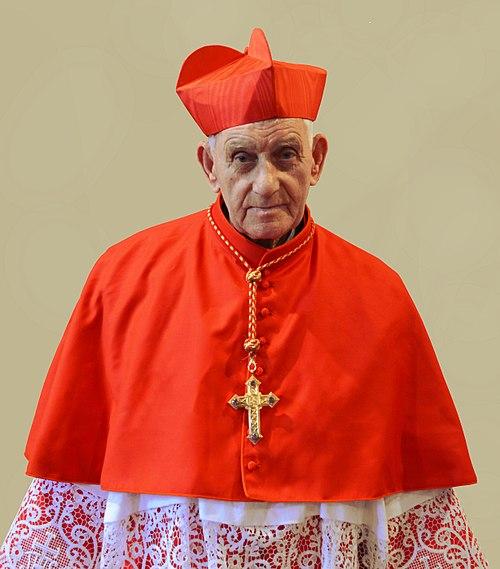
Albanian Cardinal Ernest Simoni, 97, venerates Saint Francis’s relics in Assisi, recalling his life of faith through persecution under communism.
Newsroom (23/03/2026 Gaudium Press ) On March 19, in the Italian hill town of Assisi, Cardinal Ernest Simoni of Albania—at 97 years old—stood among the final pilgrims to kneel before the fragile remains of Saint Francis of Assisi. Hours later, the plexiglass urn that had held the saint’s small skeleton since 1978 was solemnly placed once again into the stone tomb beneath the altar of the Lower Basilica.
For a month, from February 22 to March 22, more than 370,000 pilgrims from around the world came to venerate the humble bones of the man known as the “Poverello of Assisi.” Surpassing all expectations, the quiet flow of visitors formed a living river of prayer, moving gently through the frescoed spaces painted by Giotto and Cimabue—each step lit more by faith than by light.
A Lifetime Shaped by Franciscan Spirit
For Cardinal Simoni, the moment carried deep personal significance. “I give thanks to the Lord for having allowed me to be a pilgrim in Assisi and to pray for peace and fraternity before the relics of the great St. Francis, my protector, father, and teacher,” he told Vatican News.
The cardinal’s connection to Francis runs back almost nine decades. Born in northern Albania, Simoni entered a Franciscan seminary at age ten in Shkodër, taking the name Brother Enrico out of devotion to the saint of poverty and peace. His formation was brutally interrupted by Albania’s communist regime under Enver Hoxha, which declared the small Balkan state the world’s first officially atheist nation.
After his ordination in 1956, Father Simoni became one of the regime’s many victims: arrested simply for being a Catholic priest, he endured 28 years in prison and forced labor. Sentenced to death in 1963, he survived when the penalty was commuted—only to spend years in the sewers, cleaning waste by hand. Yet amid suffering, he celebrated Mass in secret, whispering Latin prayers undetected by guards who mistook them for nonsense.
When Pope Francis visited Albania in 2014, Simoni’s story moved him to tears. Two years later, the pontiff elevated him to cardinal, describing him as “a living martyr.”
Faith Beyond Bars
Simoni’s endurance under oppression stands as a modern echo of the early Church’s witness. His inventive acts of clandestine worship—transforming squalid prison corners into unseen chapels—testify to a faith that refused extinction. “I saw everything taken from me,” he once reflected, “but not my hope.”
This year, as the Church marks the 800th anniversary of Saint Francis’s “passing into heaven,” Simoni’s pilgrimage to Assisi became both a personal farewell and a continuation of an unbroken line of faith that links Albania’s suffering Church to the peace of Assisi. Despite frailty and limited mobility, he celebrated Mass at the Protomonastery of Saint Clare, prayed at her tomb, and met the cloistered sisters—his voice still resonant, his gratitude undimmed.
An Encounter of 370,000 Hearts
Friar Marco Moroni, Custos of the Sacred Convent, described the monthlong veneration as “a fraternity of 370,000 people gathered here and many others throughout the world.” He spoke of the paradox at the heart of Franciscan spirituality—the power of poor and fragile bones to ignite life animated by the Spirit.
Friar Giulio Cesareo, director of the convent’s Communications Office, admitted that the crowds were expected but not the atmosphere. “The silence, patience, and joy—this was the surprise,” he said. “None of us came to see Francis. It was Francis who called us.”
That quiet call, echoing through centuries, united an old Albanian cardinal marked by chains and a multitude of modern pilgrims seeking peace. In the hush of the Lower Basilica, beneath the stones of Assisi, the saint who once renounced everything spoke again—this time through the faith of one who never stopped answering.
- Raju Hasmukh with files from ACI prensa
Related Images:


